

Fixing the rules
The Ministry of Economic Development created a draft law concerning privatization



Here’s what you might have missed this week:
The Ministry of Economic Development prepared a draft law in response to demands by business owners to establish clear rules for privatization deals.
Russian and Ukrainian delegations wrapped up their latest round of peace talks in Abu Dhabi, resulting in a prisoner exchange.
Police in the Altai Territory raided the local offices of the Communist Party (KPRF), arresting two lawmakers and several other party workers on grounds of embezzlement.
— Sara Ashbaugh, Editor in Chief
Fixing the rules
Russia’s Ministry of Economic Development prepared a draft law on establishing a statute of limitations for challenges to privatization deals. According to the draft, this would in the future be three years from the discovery of violations, but no more than ten years from the privatization of public property.
The purpose of the draft is to calm the anxieties of business owners, who have been demanding clear rules concerning the review of privatization deals. The Russian government has seized around 6 trillion rubles worth of private assets over the past three years (more than half of them in 2025) under various pretexts, including alleged violations of privatization laws. The Russian Union of Industrialists and Entrepreneurs (RSPP) proposed establishing a statute of limitations in 2024 and has been repeatedly pushing for clearer rules. Anxieties over unbridled nationalization increased last year when President Putin appointed Igor Krasnov to head the Supreme Court. As chief prosecutor advancing scores of nationalization cases, Krasnov often clashed with the court over legal norms.
The proposed new rules only partially satisfy this request. First, they will not affect the seizure of private property under anti-corruption and “anti-extremism” legislation. Second, current legislation allows the Prosecution ample leeway to argue that the statute of limitations should be disregarded in specific cases. RSPP thus wants the Constitutional Court to append a note of interpretation to the law. In its current form, however, the proposed law does not create clear rules.
This is important because the instability of property rights and ever-shifting legal and practical norms governing ownership and taxation over the past three years have weighed down on Russia’s domestic business climate. Beyond squeezing already falling profit margins in the civilian economy, uncertainty can depress hiring and investment planning. Due to fiscal shortfalls (see below), the tax system, another major pain point for employers, is still in flux. The Ministry of Finance is currently preparing to increase taxes on imported non-food products and to introduce an export duty on diamonds. The tax office has reportedly also increased the frequency with which it is trying to revise and collect older debts from companies, in line with the Kremlin’s desire to shore up budgetary income by increasing the efficiency of tax collections.
— Andras Toth-Czifra
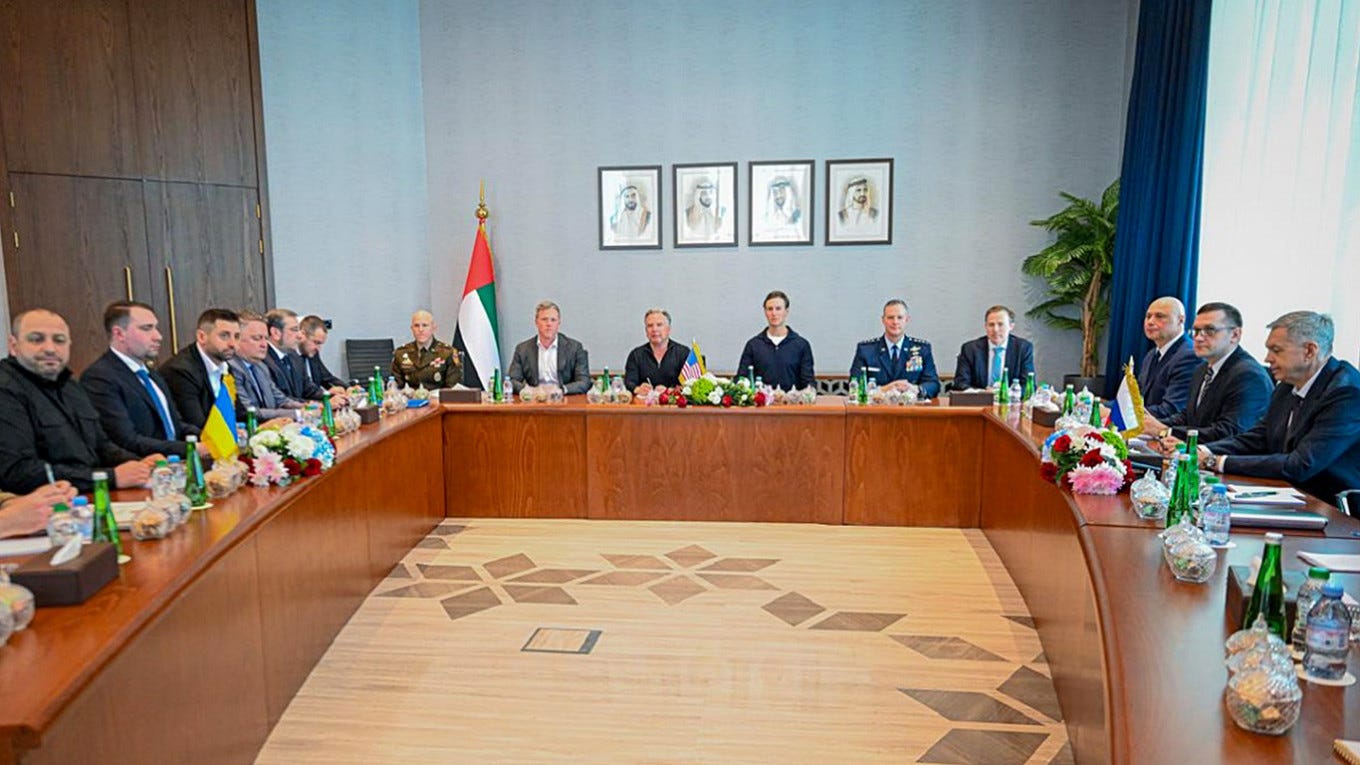
Russian and Ukrainian delegations wrapped up their latest round of peace talks in Abu Dhabi on Thursday. Afterwards, U.S. Special Envoy Steve Witkoff announced that the two countries had agreed on a prisoner exchange involving 314 prisoners of war. “This outcome was achieved from peace talks that have been detailed and productive,” Witkoff posted on X. A source on the Russian side, however, said that a peace agreement is still far off. “The work is being carried out in a multifaceted and phased manner. It’s unlikely to be completed in a month,” the source told TASS. This week’s peace talks were the second this year in Abu Dhabi, the first having taken place January 23-24. (photo: Press Service of the UAE Ministry of Foreign Affairs / TASS)
Quickfire: Regions
A month after nine newborns died in a maternity clinic in the Kemerovo Region, another preventable health care disaster struck the region over the past week. Nine patients died of a viral infection in a psychiatric facility in the city of Prokopyevsk, with many others hospitalized. Similar to the January tragedy, federal probes were ordered into the case and into other psychiatric facilities. While it is possible that the negligence of individual employees played a role, this time Governor Ilya Seredyuk had to admit that the region’s health and social care services were in a “critical condition.” Even after the January tragedy, staff shortages in spite of hospital closures were cited as a contributing factor. Health care spending in the region in the first eleven months of 2025 has been lower in nominal terms than at any point since 2021. The regional budget, which is responsible for maintaining hospitals, had to make several cuts over the past two years due to the slow-burn crisis of the coal industry—the backbone of the region’s economy. The poor state of health and social services, however, also reflects years of underinvestment into public infrastructure. Under the current federal and regional fiscal constraints, most regions are ill equipped to solve this problem.
Police in Siberia’s Altai Territory carried out raids in the offices of the local branch of the Communist Party (KPRF) over the past week and arrested two lawmakers and other party workers accused of embezzlement. The KPRF’s Altai Territory branch has been one of the most active and strongest regional branches over the past years. Regional Communist politicians have regularly organized and participated in protests triggered by bread-and-butter issues such as utility price hikes and poor quality public services. In late 2025, local law enforcement had already interrogated, searched, and arrested several local Communist politicians and their employees. The party, just like now, called this an attempt to pressure the branch to tone down its criticism of the regional government and not mount a serious challenge in regional elections that are scheduled to take place in September, together with elections to the State Duma. Maria Prusakova, the head of the local party branch, also said that unconfirmed reports about a police probe into her activities were part of this pressure campaign. Over the past weeks, regional authorities in several regions blocked opposition deputies’ meetings with voters, equating them with unauthorized protests.
— Andras Toth-Czifra
From the frontlines
FPRI Senior Fellow Rob Lee speaks with members of the 7th Rapid Response Corps of Air Assault Forces about the use of unmanned ground vehicles (UGVs) on the Pokrovsk axis. The trio discusses how Defense Forces deploy UGVs, replacing personnel in the most dangerous logistics and evacuation missions. They also discuss whether UGVs can be used as assault platforms and discuss where UGV development is heading this year.
Numbers of the week
393.3 billion rubles – the amount of oil- and gas-related revenues that the Finance Ministry reported for January. This is roughly half the amount of last January’s income and the lowest nominal monthly figure since July 2020, when the COVID pandemic depressed oil sales. The falling income is a consequence of widening discounts on Russia’s Urals oil and low global oil prices, with a negative outlook.
199 – the number of rapes registered in the Belgorod Region in 2025. This grim statistic in the region bordering Ukraine grew threefold over the past year. The upwards trend started in 2022, as did Russia’s full-scale invasion that brought soldiers into Belgorod. Last year, more rapes were committed in the region than in the much more populous Moscow Region.
9.6% – the profitability of sales in the Russian metallurgical sector in the first eleven months of 2025, according to the Kremlin-linked think tank CSR, down from 28.7% in 2021. A sharp decline in domestic demand, higher prices, and rates have pushed the sector towards a crisis, which may weigh down regional budgets as early as this year.
1,280 – the number of accidents and outages involving utility networks reported in January in Russia, according to Novaya Gazeta. This is almost twice as high as in January 2025 (although lower than in 2024). In most cases the outages are caused by worn-out infrastructure, replacements for which the federal budget has not prioritized.
1.7 trillion rubles – the Russian federal budget deficit in January, according to data published by the Finance Ministry. Federal budget revenues in January 2026 were 11.6% lower than in 2025, and this year’s January deficit exceeds last year’s by 17%. “The high deficit at the beginning of the year was primarily due to the accelerated financing of expenditures within the year and will not impact the overall achievement of the structural balance targets for 2026,” the Ministry says.
— Andras Toth-Czifra & Sara Ashbaugh