

Four years on
The war between Russia and Ukraine enters its fifth year



Here’s what you might have missed this week:
U.S. officials met with Russian and Ukrainian negotiators in Geneva for continued peace talks, which have so far produced little results toward ending the war.
Hungary and Slovakia are blocking a 90-billion-euro loan to Ukraine until oil supply resumes through the damaged Druzhba pipeline.
Two leading Russian economic experts criticized the government’s economic development strategy, especially regarding the Siberian regions.
— Sara Ashbaugh
Peace talks stall
Tuesday marked the fourth anniversary of Russia’s full scale invasion of Ukraine. As the war grinds on, continued peace talks between the U.S., Russia, and Ukraine have yielded little results. This year’s third round of U.S.-led peace talks took place on Thursday in Geneva, where U.S. representatives met separately with Ukrainian and Russian delegations. They reportedly discussed ongoing territorial disputes, details for the next trilateral meeting, and plans for post-war Ukrainian reconstruction, among other things. Negotiations have essentially reached a dead end, a senior NATO official told The Moscow Times, as long as Russia sticks to its maximalist demands. Specifically, the demand that Ukraine cede the entire Donbas region to Russia has been a major sticking point. Earlier this month, President Zelenskyy told reporters that the White House is pushing for a settlement by this summer. According to Bloomberg, citing U.S. allies, President Trump wants to secure a ceasefire agreement before July 4. Moscow and Washington are now waiting to see “who will fold first,” the anonymous NATO official said.
According to Zelenskyy, negotiations are expected to resume in Abu Dhabi in early March. During one of his recent evening addresses, Zelenskyy advocated for a direct meeting between the three presidents. “We need to finalize everything that has been achieved in terms of real security guarantees and prepare for a meeting at the leadership level,” he said, adding, “This format can solve a lot.” President Putin has so far appeared reluctant to meet with Zelenskyy directly, publicly questioning the Ukrainian leader’s legitimacy.
Meanwhile, Russia and Ukraine have continued to exchange the bodies of fallen soldiers under the agreement they reached in Istanbul last June. On Thursday, Russian official Vladimir Medinsky announced that Russia sent 1,000 bodies to Ukraine this week and received 35 in return. The reason for the discrepancy between the two sides is unclear. Both countries have suffered heavy losses during the war; the Washington-based Center for Strategic and International Studies (CSIS) estimates overall military casualties at about 1.8 million, including up to 465,000 killed. In early February, President Zelenskyy claimed that 55,000 Ukrainian troops have been killed on the battlefield, which is likely an underestimate. The CSIS places the figure between 100,000 and 140,000, and estimates that up to 325,000 Russian soldiers have been killed as well.
— Sara Ashbaugh
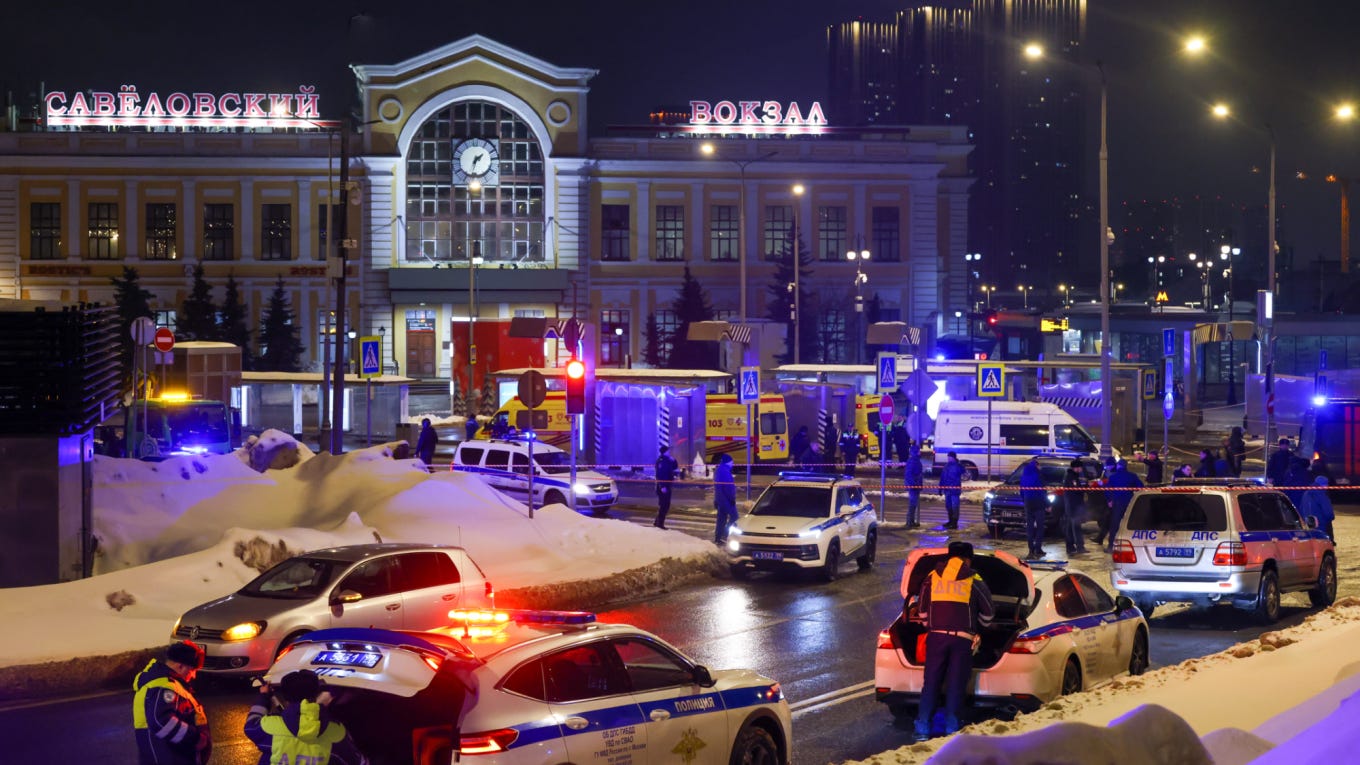
Police cordoned off the Savyolovsky Railway Station Square in Moscow on Tuesday after an explosive device was detonated in the area. The blast, which occurred just after midnight, killed one police officer and injured two others. According to Russia’s Interior Ministry, an attacker approached the officers and triggered “an unidentified device” in an apparent suicide bombing. The suspect was identified as a 22-year-old man from the Udmurt Republic in west-central Russia. His possible motive has not yet been established. (photo: Pavel Seleznev / TASS)
Severed Druzhba
The Hungarian and Slovakian governments are blocking the release of a 90-billion-euro loan to Ukraine that the two countries previously agreed to, as well as further sanctions on Russia, until oil supplies via the damaged Druzhba pipeline are relaunched. The Slovakian government has also stopped its emergency electricity supplies to Ukraine until oil shipments resume. Meanwhile, a Ukrainian drone strike damaged a key pumping station near the Tatarstan town of Kaleykino, which also serves the Druzhba, prompting Transneft to cut its intake from the Tatneft oil company. The two governments have not made similar demands to Russia over this disruption.
The Ukrainian government attributed the supply disruption through the Druzhba, which started on January 27, to a Russian drone strike on the pipeline near the Brody oil hub in Ukraine. While Ukrainian authorities have said that they are conducting repairs, they also underlined that reliable supply through the pipeline will be impossible as long as Russian attacks against Ukraine’s energy infrastructure continue. To replace the oil supply, Ukrainian officials offered a bypass through the Odessa-Brody pipeline using non-Russian oil.
Instead, Hungary and Slovakia opted for increased supplies of Russian oil via the JANAF pipeline in Croatia, arguing that their current exemptions from EU sanctions on the import of Russian oil allow them to do so. This move, in turn, resulted in a diplomatic spat between the Croatian and Hungarian governments over Slovakia and Hungary’s ongoing prioritization of Russian oil, which Croatia rejects, and whether or not the capacity of the JANAF pipeline is enough to ensure the energy security of Hungary. Due to the disruption in supply, Hungary’s strategic reserves were opened, so the country does not face an immediate crisis. However, MOL, Hungary’s largest oil company (which also operates Slovakia’s Slovnaft refinery), claimed that it will have to reduce production in its refineries to 70-80% of capacity, as they are still not fitted to process non-Russian crude.
On February 27, Hungary and Slovakia agreed to participate in a joint committee to investigate the damage to the pipeline. This suggests that they are facing some pressure from EU peers, but it is unclear whether it will precipitate the withdrawal of the veto. On the same day, the Hungarian Foreign Ministry claimed that the Ukrainian government “admitted” to Hungary’s charge d’affaires in Kyiv that the delay in repairs is politically motivated. Ukraine has denied this.
The Slovakian and Hungarian responses come as both governments face increased domestic opposition. The Slovak opposition has been roundly critical of their government’s increasingly pro-Russia stance. In Hungary, according to a recent poll, the Fidesz Party of Prime Minister Viktor Orban may be twenty points behind its opposition challenger, the Respect and Freedom (Tisza) Party, only five weeks before a parliamentary election. If the Tisza Party wins, it would mean the end of Orban’s 16-year rule as Hungary’s prime minister.
In 2022, following the start of Russia’s full-scale invasion of Ukraine, Fidesz surged in the polls after Orban argued that an opposition victory would mean Hungary would be “dragged into the war.” Since then, his party has continuously campaigned with the same rhetoric, which has an increasingly aggressive anti-Ukrainian flair. This week, Orban ordered the deployment of army units to key energy facilities, claiming, without evidence, that Ukraine was preparing further disruptions in the campaign period. The leader of the Hungarian opposition in turn accused Orban of preparing a false-flag attack. Rhetorical sabre-rattling against Ukraine in the Druzhba case fits into Fidesz’s campaign tactics, as does the allusion that, if a less Kremlin-friendly government comes to power, Hungarians will face much higher gas prices (even though gas prices are already the second highest in the region).
— Andras Toth-Czifra
Quickfire: Regions
Two important figures in Russia’s economic elite delivered remarks very critical of Russia’s current economic development trajectory at a conference in Krasnoyarsk this week. Industrialist Oleg Deripaska called the courts, the prosecutor’s office, and the quality of regional governance the main barriers to investment (referring, most likely, to recent nationalization cases), and called for special economic zones for Siberia. The livestream of his panel was subsequently removed from the VK social network. The Chief Economist of Vneshekonombank (VEB), Andrei Klepach, declared the government’s current Siberian development strategy “unviable,” saying it amounts to little more than generic theses about exploiting natural resources through a “cluster approach.” Even more importantly, Klepach remarked that money previously earmarked for the development of the public and economic infrastructure of Siberian regions is now being redirected westward to the occupied territories and border regions. The remarks of both men constitute a rebuke, with relative bluntness, of the government’s current spending priorities and the growing influence of the Federal Security Service.
The Kremlin’s concerns over widespread complaints about rapidly growing utility bills across Russia have apparently triggered a high-level response. During a discussion about Prime Minister Mikhail Mishustin’s report on the government’s work in the State Duma, in an answer to a question by Duma Speaker Vyacheslav Volodin, the Prime Minister placed responsibility for these price hikes squarely on regional regulatory bodies, saying that some of them should be “disqualified.” Mishustin also underlined a bill adopted in the first reading that would give the Federal Antimonopoly Service (FAS) the power to set tariffs directly in the regions. The Prime Minister’s remarks, which avoided discussing the effect of the federal government’s decision to raise the rate of VAT or upcoming larger utility tariff hikes scheduled for October, fit very well into the Russian government’s usual crisis management strategy. This strategy decentralizes political responsibility for unpopular developments while absolving federal institutions, in this case both the government and FAS, which last week found no evidence of major tariff hikes.
— Andras Toth-Czifra
From the frontlines
FPRI Senior Fellow Rob Lee and the Kyiv Independent’s Francis Farrell speak with Lieutenant Colonel Yevhen Bespalov, the Commander of Ukraine’s 38th Marine Brigade, about the current situation in Myrnohrad, the role of Russia’s Rubicon Center, how Ukrainian forces navigate constant Russian pressure, the heavy use of glide bombs, and a significant enemy manpower advantage.
Numbers of the week
50/55 - according to Russian media reports, the Kremlin’s new target for the governing United Russia party to hit in the September 2026 State Duma elections is 55% support at a 50% turnout. The turnout target was apparently revised downwards from 55%, suggesting that the Kremlin is aware of growing social discontent and thus aims to mobilize only “reliable” voters.
60-70% - the average wear level of heating utility pipes in Russian cities, according to experts. With replacement rates running at 2.2% annually (against a planned 5%) and the government failing to put previously promised financing behind the renewal of networks, the public infrastructure gap is actively widening each year. This leaves approximately 41 million Russians in areas with unreliable heating.
39% - the share of expenditures on food in the budget of the average Russian household, according to Rosstat data. This is the highest figure since 2008 and a 2.1-point growth on pre-2022 levels. A growing share of household spending on food is usually a marker of increasing poverty and declining living standards.
$22 billion - Sberbank’s reported profit for 2025. This is 7.9% higher than the bank’s net profit last year and represents its third consecutive year of growth. Sberbank CEO Herman Gref attributed the bank’s success to AI, saying, “Organic integration of artificial intelligence into processes and the daily lives of people has become a key driver of our growth.” When Western sanctions were imposed in early 2022, Sberbank was one of the first companies hit, resulting in a 75% plunge in profits. This year’s net profit, however, is even higher than pre-war levels, setting a new record.
859,000 barrels per day - the volume of Russian oil imported by India in January 2026. January’s oil imports were 40% lower compared to December’s and less than half of what they were last year, according to Argus, an independent price reporting agency. Reuters found that Russia’s share of India’s total oil imports fell to 21.2% in January, the lowest it has been since October 2022. India’s reduction in Russian oil purchases is likely an attempt to appease the U.S., which placed significant tariffs on India over its reliance on Russian oil.
— Andras Toth-Czifra & Sara Ashbaugh
12 years on...
"I think we're in play . . . [VP] Biden is willing to give it the attaboy . . . because Fuck the EU."
https://www.youtube.com/watch?v=tFJvLEjvlA4