

Fruitful attacks
Ukraine targets Wildberries warehouses with a new wave of drone strikes



Here’s what you might have missed this week:
Ukraine hit several Wildberries facilities in Russia and occupied Ukraine, disrupting Russia’s largest online retailer.
Deputy Prime Minister Alexander Novak claimed that Russia’s domestic fuel market is stabilizing, although experts warn that the crisis is not yet over.
China has stopped giving Russia technology for its large-tonnage ice-class ships, hindering Russia’s Arctic development.
— Sara Ashbaugh
Attacks on Wildberries
Apart from continuing drone attacks on Russia’s oil refining and export infrastructure, Ukraine also carried out several successful attacks against Wildberries warehouses. Wildberries is Russia’s largest online marketplace. It has links to businessman Suleiman Kerimov and its de facto owner pitched it to the Kremlin as Russia’s most comprehensive future online platform. On July 18, drones hit two warehouses, in the Moscow and Tambov regions, reportedly killing eight people and injuring several dozens. Four days later, two warehouses in Southern Russia were hit and a fifth one was reportedly damaged the next day. In the Moscow Region facility alone, the estimated value of the goods destroyed was 150-200 billion rubles, with reconstruction costs amounting to up to a fifth of the company’s 2025 profits. Wildberries also lost an estimated 7% of its logistics capacity.
The most significant consequence of the drone strikes stemmed from the cost-shifting measures adopted by online marketplaces shortly before and after the attacks. Both Wildberries and Ozon, a major competitor, recently amended their terms to release themselves from responsibility for claims by sellers whose wares were damaged in military strikes. Yandex Market, another online marketplace, added a similar provision shortly after the first wave of attacks. This effectively puts the financial burden resulting from the attack on sellers, mostly small businesses that use these platforms. Wildberries later offered storage discounts and preferential loans to sellers that were affected but, according to Vyorstka’s reporting, this has only partly materialized.
The cost-shifting itself is a consequence of the federal government shifting the burden of drone protection and recovery onto large companies. Meanwhile, the Association of Electronic Market Commerce Participants (AUREK) requested help from the federal government in the form of a tax deferral. Russia’s parliament also started to discuss amendments to the law on platform economies to offer better protection for small businesses from liability in similar cases, effectively shifting the burden back onto platforms. Despite this, it looks like the government is keen to keep the financial burden associated with anti-drone measures on businesses. If marketplace warehouses indeed become regular targets for drones, the restructuring of logistics networks will also incur major costs for these companies.
— Andras Toth-Czifra
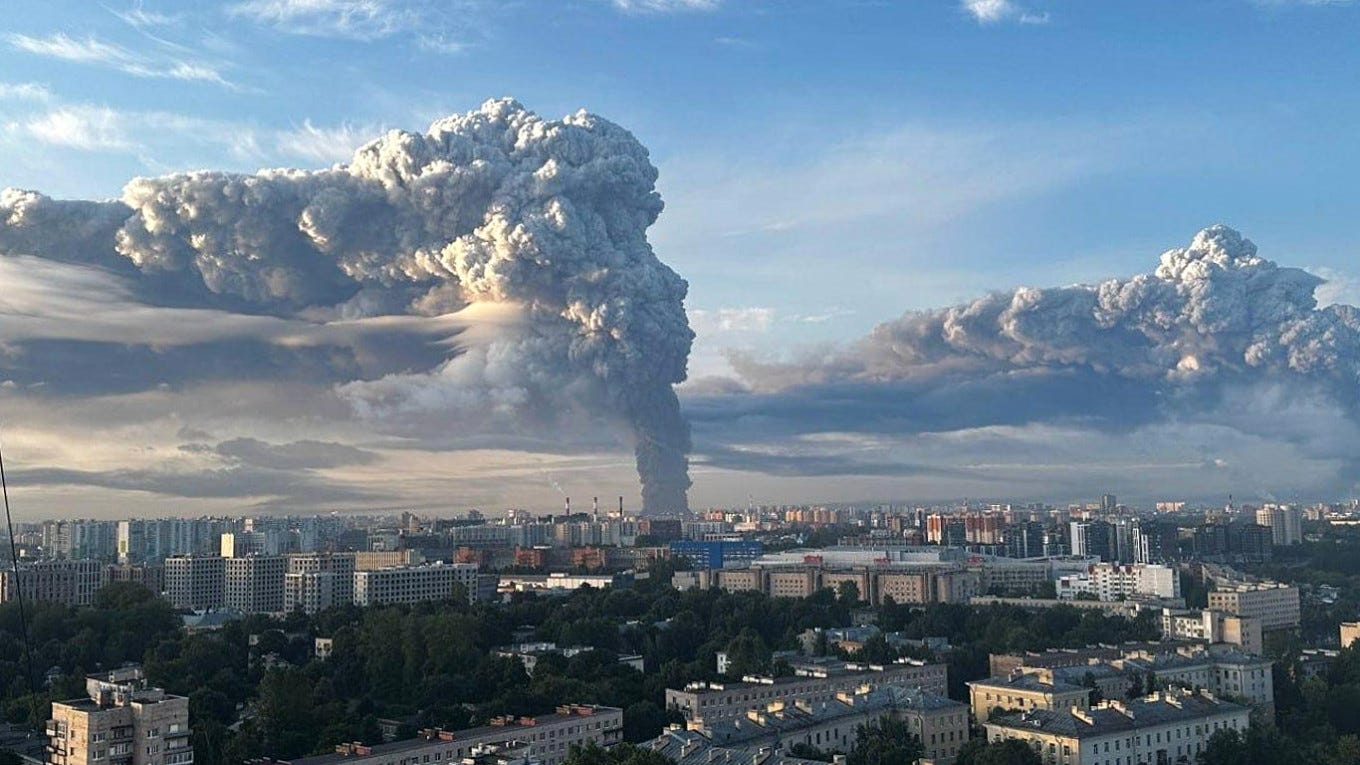
Ukraine continued to target Wildberries warehouses throughout the week, going on to strike several facilities in occupied Crimea and the Leningrad Region. Massive plumes of smoke could be seen rising over St. Petersburg after drone strikes set fire to a Wildberries logistics hub and storage complex early Friday morning. Leningrad Governor Alexander Drozdenko said three people were injured in the attack. Ukraine has now attacked eight Wildberries facilities in total, crippling up to 10% of the company’s logistics capacity, according to Reuters. Wildberries founder and CEO Tatyana Kim posted about the strikes on Telegram, writing, “All our efforts are currently focused on redistributing inventory across warehouses to optimize turnover and ensure the economic stability of our partners.” (photo: Telegram)
Quickfire: Regions
On July 21, Deputy Prime Minister Alexander Novak claimed that Russia’s domestic fuel market was stabilizing and that queues and restrictions were easing in several regions. This was partially confirmed by independent analysis. Some refiners returned to the St. Petersburg fuel exchange this week, although the permitted price band for gasoline had been widened. Industry experts, while permitting that Russia may have passed the peak of the crisis, warned that production could not be substantially increased and demand would remain high in the summer months. It is also possible that the easing pressure is due to more efficient internal logistics, as the situation has not improved uniformly in all regions. Siberian and Far Eastern regions in particular report continued problems with fuel provision, and there are reportedly problems with fuel deliveries in the occupied Ukrainian territories as well, complicating troop movements. From the point of view of domestic politics, the government’s ability to diminish the most visible marks of fuel shortages—queues and fuel purchase restrictions—before the September Duma elections will be the key challenge.
Тhe business newspaper Vedomosti reported last week that China stopped providing Russia with technology for large-tonnage ice-class ships. Russia needs this technology in order to develop the navigability of the SMP, as its shipyards currently do not have access to domestic technology of this sort. Further delays in the development of the SMP into a major trade route will in turn make the private-sector investment foreseen by the federal government for Russia’s Arctic cities less likely to materialize. The plans for 15 Arctic “anchor cities,” including over 500 infrastructure development projects over the next 10 years, have a headline budget of 2.9 trillion rubles (roughly 60% of which is assumed to be private investment). Given that most regions along the Arctic coast have faced increasing fiscal strain over the past years, it is unlikely that regional budgets will be able to fill the gap.
— Andras Toth-Czifra
In The Latest Russia-Belarus Non-Strategic Nuclear Exercise, Putin and Lukashenka Show Teeth
By Gabriela I. Rosa-Hernandez & Decker Eveleth

In mid-May, Belarus and Russia announced that they would conduct military exercises involving the delivery of nuclear weapons to units in the field. Over the next three days, imagery emerged of Russian and Belarusian forces practicing for the employment of nuclear weapons, including mock deliveries of nuclear warheads to Belarusian missile units. The exercises were trumpeted by both Russian and Belarusian political leadership as an important step in achieving both Russian and Belarusian security against foreign threats. President Vladimir Putin said this exercise was the first joint training of the Russian and Belarusian armies on the management of strategic and tactical nuclear forces since Russia and Belarus announced their nuclear-sharing arrangement—perhaps the most significant change in Russia’s nuclear posture since its full-scale invasion of Ukraine.
By the numbers
-6.4% - the drop in regional consolidated spending on clinics and hospitals in the first quarter of 2026 compared to the same period in 2025, according to Medvestnik (the figure is -5.2% excluding Moscow). This drop suggests the continuation of an earlier trend whereby health care spending, which makes up a considerable part of regional budgets (mostly on regional hospitals and health care personnel), is cut as regional budgets face a squeeze. This spending is being cut despite the coming challenge of returning war veterans.
66% - Vladimir Putin’s approval rating according to the Public Opinion Foundation, a government-linked pollster, after its largest drop (of 5 percentage points) during the duration of Russia’s full-scale war against Ukraine. Although the approval rating cannot be taken at face value, the fact that the Public Opinion Foundation published a major drop is nonetheless significant. It implies a message that the recent fuel crisis and more frequent drone attacks risk destabilizing the domestic political situation.
25 bps - The amount by which the Central Bank of Russia (CBR) lowered its key rate on Friday, from 14.25% to 14%. This is the tenth time in a row that the Bank has decreased the rate, continuing its recent trend of conservative rate-cutting. Many experts expected the CBR to maintain the rate at 14.25% in response to rising inflation and the ongoing fuel crisis. Instead, the Bank opted for a smaller rate cut, stating that “a smoother key rate decrease is required” to address production decline in “certain sectors.” The Bank’s next key rate meeting will be held on September 11.
$44.10 per barrel - The price cap on Russian crude oil, frozen by the EU for the next 12 months. The measure is part of the EU’s latest sanctions package against Russia, which also targets 48 individuals and 170 organizations (including 94 banks). Objections by Greece almost derailed the package; Greece finally agreed to freeze the oil price cap in exchange for an exception to the sanctions that allows it to ship Russian liquefied natural gas to countries outside of the EU. As a result, the bloc agreed to freeze the price of Russian crude oil at $44.10 for the next year in order to stop Russia from benefiting from rising oil prices stemming from the war in Iran.
— Andras Toth-Czifra & Sara Ashbaugh