

Gas tank on E
New fuel sale restrictions hint at Russia's diminished oil refining capacity



Here’s what you might have missed this week:
The Russian government introduced additional fuel sale restrictions after Ukrainian drone strikes severely limited oil refining capacity.
Tensions between Russia and Armenia have escalated leading up to Armenia’s parliamentary elections this June.
The Russian Finance Ministry failed to sell its stake of gold mining company Yuzhuralzoloto at auction after the only bidder was disqualified.
— Sara Ashbaugh
Fuel export ban
There have been an increasing number of reports of fuel sale restrictions from Russian regions over the past week, both in Central Russia and in remote regions. According to the official explanation quoted by the pro-Kremlin press, these are due to “unscheduled repairs” at oil processing facilities representing up to a fifth of oil refining capacity. It is likely that these repairs have to do at least partially with damage caused by Ukrainian drone strikes, the scale of which has significantly intensified over the past weeks.
This week, a major refinery in the Perm Territory was hit again, as was the Grushovaya Balka oil terminal complex in Krasnodar—a major storage unit that had not been hit yet—and a refinery in Syzran in the Samara Region. Six refineries have been affected this month alone. According to Reuters’s sources, even before the Syzran strike, almost all major refineries in Central Russia had been forced to reduce or suspend production, leading to shortages of AI-95 and AI-92 gasoline. The shortages are especially severe at independent gas stations; although, as industry experts have warned, the damage is difficult to quantify due to closed statistics and regular seasonal spikes in fuel consumption and repairs.
The Russian government imposed ongoing restrictions on fuel exports last summer: gasoline export bans through July 2026, diesel export bans on resellers also until the end of July 2026, and import duties on marine fuel and other distillates. Since early May, the Ministry of Energy has had agreements with 11 oil companies that allow it to issue directives on production volumes and domestic deliveries. It has now emerged that the government is planning to ban jet fuel and diesel exports, even though earlier the government said it was not planning to expand the export bans.
While it may be too early to talk about a full-blown domestic fuel crisis, the trajectory is worth monitoring. Over the past weeks, there has been noticeable worry about Ukrainian drone strikes in Russia, especially since the federal government continues to defer the costs of protecting key industrial facilities to the companies themselves.
— Andras Toth-Czifra
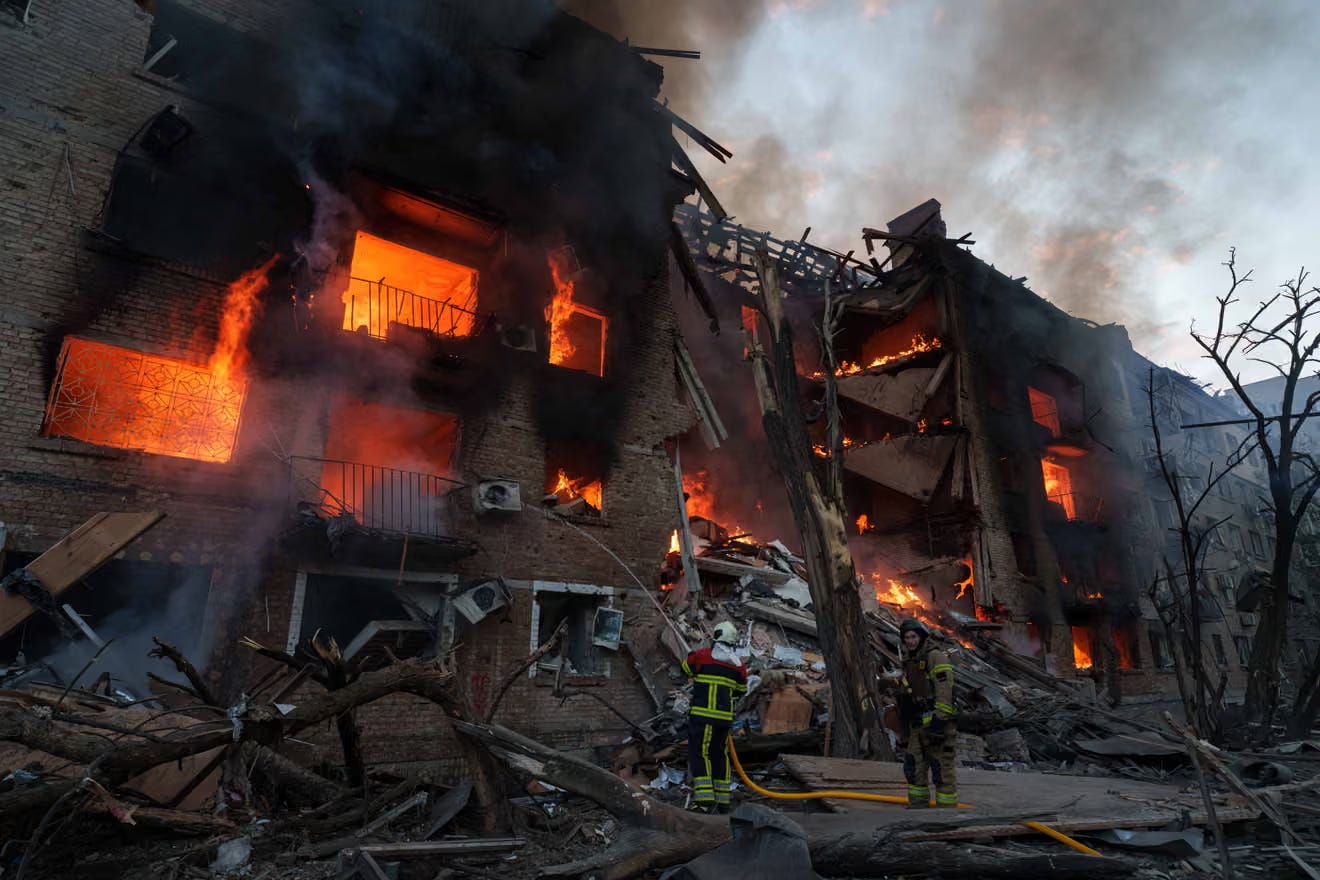
Russia carried out a major attack on Ukraine over the weekend, including the use of an Oreshnik ballistic missile near the capital city of Kyiv. According to the Ukrainian Air Force, Russia launched 600 drones and 90 missiles at Ukraine early Sunday morning, killing at least four people and wounding 100 others in and around the capital city. The Oreshnik missile struck the city of Bila Tserkva in the Kyiv region, marking the third time that Russia has used the nuclear-capable missile over the course of the war. Sunday’s strike was in retaliation for a deadly Ukrainian attack on the occupied Luhansk region, which hit a college dormitory and killed 21 people. Following the Russian attack, Ukrainian President Volodymyr Zelenskyy asked the U.S. for additional Patriot PAC-3 missiles and other air defense ammunition. (photo: Evgeniy Maloletka / AP)
Strained relations with Armenia
Tensions between Russia and Armenia have escalated in the last few weeks leading up to Armenia’s June 7 parliamentary elections. Armenia has distanced itself from Russia in recent years, choosing instead to align more closely with Europe. As the elections approach, Russia has ramped up the pressure on Armenia to drop its EU aspirations, including by threatening to cut off Armenia’s duty-free access to Russian gas and petroleum.
There has been friction between the two countries since 2023, when Russia failed to defend Armenia from Azerbaijan’s incursion into Nagorno-Karabakh. In 2024, current Armenian Prime Minister Nikol Pashinyan supported a referendum on joining the EU, and the EU Integration Act was officially adopted in 2025. Earlier this month, Armenia hosted the European Political Community (EPC) summit for the first time—a major diplomatic event attended by more than 40 European heads of state. Ukrainian President Volodymyr Zelenskyy participated in the summit, leading Kremlin spokesperson Dmitry Peskov to accuse Armenia of platforming “anti-Russian statements.” Pashinyan also did not attend Moscow’s Victory Day parade this year, claiming that he needed to focus on his parliamentary campaign.
Russia would like to see Pashinyan and his Civil Contract Party lose to pro-Russian opposition figures in the upcoming elections, such as Armenian-Russian billionaire Samvel Karapetyan or former Armenian President Robert Kocharyan. However, Pashinyan is leading in the polls, and U.S. President Donald Trump even endorsed his campaign. According to Reuters, Russia recently launched a covert scheme to influence the elections that includes a disinformation campaign and plans to transport Armenian-Russian voters to the polls. The Russian Foreign Ministry labeled these accusations “anti-Russian rhetoric.”
Meanwhile, Russia has restricted its imports of Armenian flowers, alcohol, mineral water, and produce, and threatened to terminate a 2013 natural gas agreement that guarantees Armenia duty-free deliveries of Russian gas and petroleum products. “Being in a customs union with the European Union and the Eurasian Economic Union is impossible. It’s simply impossible by definition,” President Putin said during a bilateral meeting with Pashinyan last month. Putin also drew a notable parallel between Armenia and Ukraine in his remarks after this year’s Victory Day parade. “We all see what’s happening with Ukraine now. But where did it all start? With Ukraine’s attempt to join the EU.” he said.
— Sara Ashbaugh
Quickfire: Regions
Tatarstan is planning to introduce fines for employers that fail to observe “veteran quotas” introduced by law last year. The oil-rich region is one of the first regions to be moving in the direction of stricter enforcement of the rules introduced to assist the reintegration of Ukraine war participants. This suggests that, similar to some other regions that have introduced quotas, employers are often unwilling to take on the burden of retraining and reintegrating traumatized former soldiers. Earlier, Chief Prosecutor Alexander Gutsan criticized the efforts to reintegrate veterans into the job market, remarking that only 1 in 2 returning war participants who sought employment assistance in 2025 found work and that the retraining programs were inefficiently organized. The fact that Tatarstan is moving ahead with stricter regulations may suggest that the Kremlin wants other regions to follow suit. Meanwhile, United Russia deputies in the St. Petersburg City Assembly suggested a one-time payment for SVO veterans who are not in permanent employment.
For the second time in two weeks, the Finance Ministry failed to auction off Yuzhuralzoloto, a gold mining company nationalized last year from a regional deputy in the Chelyabinsk Region who was accused of illegally using his political influence to acquire the company. In the first auction there were no bidders, and in the second Dutch-style auction there was only one bidder, Russkie Ugli, which was disqualified for unclear reasons. It could be that potential buyers are simply waiting for the Russian government, which is trying to plug growing revenue gaps in the federal budget, to offer its stake at a more heavily discounted price. However, the lack of interest also suggests growing unease about the state of property rights in the country. Several trillions of rubles worth of assets have been seized from private owners since the start of Russia’s full-scale invasion of Ukraine.
— Andras Toth-Czifra
Russia’s Drone Line Experiment
By Rob Lee and Dmytro Putiata
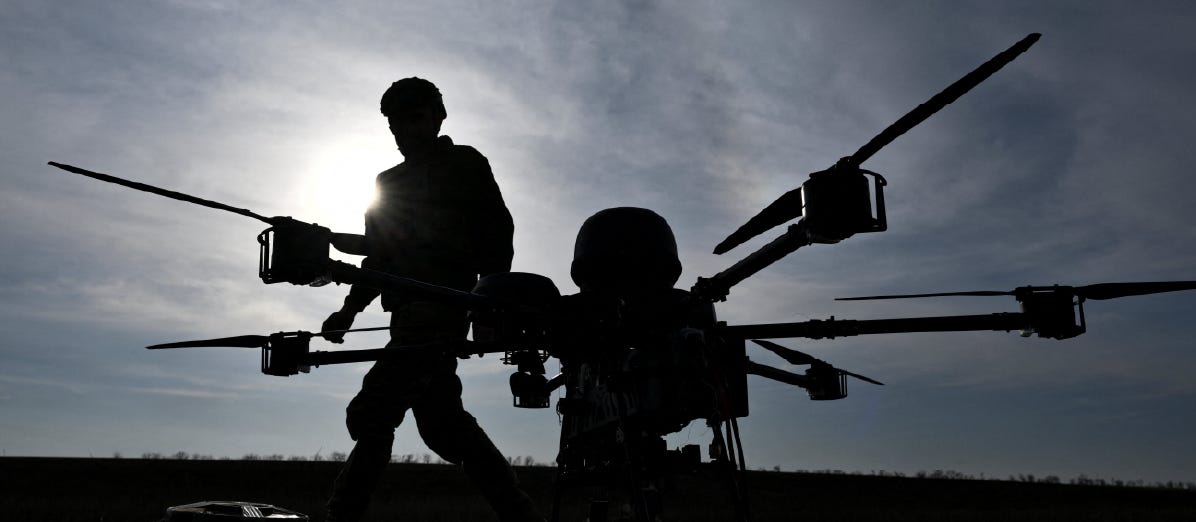
The Russian military has continued to experiment with improving its employment of uncrewed aerial systems (UAS) in support of its maneuver forces.
Both Russian and Ukrainian forces face coordination challenges and internal debates regarding the “ownership” of different depths of the battlespace and the command-and-control relationship between independent drone units and ground commanders.
While Ukraine typically leads in initial technological innovation, Russia has proven effective at copying these advancements and scaling them through systemic experiments across various military districts.
Despite narrowing the capability gap in 2025 through new employment concepts and elite units, Russian advancements have failed to produce a decisive military breakthrough.
For more from Rob and Dmytro, subscribe to Two Marines, a newsletter on Russia’s war in Ukraine, defense technology, and modern warfare.
By the numbers
2.9 billion rubles - the total amount of unpaid wages across Russia as of late April, according to newly released Rosstat data. This is a 35.2% increase compared to March and almost 100% higher than the figure was in April of last year. According to reporting by Meduza, Russian state-run media sources have been instructed to “ignore” the Rosstat data on wage arrears and refrain from reporting on it as much as possible.
5.5 billion rubles - the value of assets seized by a Moscow court from former First Deputy Defense Minister Ruslan Tsalikov and his family. This is the largest single confiscation from any defendant in the ongoing series of corruption cases against former defense ministry officials. Tsalikov, who is accused of large-scale corruption, has been a long-time associate of former Defense Minister and current Security Council Secretary Sergei Shoigu.
7.94 trillion rubles - the total revenue of the Russian IT sector in 2025, representing the first decline in several years (by around 60 billion rubles), despite an increase in the number of companies operating. Industry experts interviewed by Kommersant attributed this to structural changes within the industry. However, falling revenues may also signal that an earlier boom, supported by import substitution efforts, is running out of steam.
600,000 Lithuanians - the number of people affected by a recent data leak from the Lithuanian state-run Real Estate Register. Personal information, including identification numbers, was stolen during the leak, and the Director General of Lithuania’s Center of Registers was forced to resign as a result. According to the Prosecutor General’s office, the data leak originated from a “foreign state,” with several Lithuanian politicians pointing the finger at Russia.
— Sara Ashbaugh & Andras Toth-Czifra