

Gassed out
Ukrainian drone strikes continue to restrict Russia’s fuel supply


Here’s what you might have missed this week:
Ukrainian drone strikes on the Kapotnya Refinery near Moscow halted production, further exacerbating Russia’s ongoing fuel crisis.
Social media posts claim that the authorities in the city of Penza are conducting mobilization raids and pressuring local men into signing military contracts.
A leaked document shows major changes to the Russian Communist Party’s lineup for the upcoming State Duma elections.
— Sara Ashbaugh
Fuel crisis continues
Disruptions in Russia’s domestic fuel market exacerbated by the ongoing Ukrainian drone campaign continued over the past week.
The most significant development this week was a report by Reuters claiming that, based on internal sources, the Kapotnya Refinery near Moscow (which was hit repeatedly on June 16 and 18) will not be able to resume operations until 2027 at the earliest. This suggests that the Ukrainian strikes did an unusually large amount of damage to the primary distillation units of the refinery, which supplies a significant portion of the Russian capital’s fuel. Despite official data showing essentially no rise in air pollution in the districts around the refinery, local residents have reported dark material on cars and buildings, combining the psychological effect of the footage of burning refineries and faulty air defense systems with frustration over failing crisis response.
Meanwhile, a third wave of drones reached Moscow on June 22. Beyond the capital, the past few days also saw several successful Ukrainian drone strikes: on the Lukoil refinery in Kstovo in the Nizhny Novgorod Region, on Gazprom’s gas processing and helium plants in the Orenburg Region, on a semiconductor plant in the Voronezh Region, on a fuel depot in the Krasnodar Territory, on an oil processing complex in Bashkortostan, on a refinery in the Tyumen Region, on the Vladimir and Dubna space communications centres, on the Kerch ferry port, and on an important gateway of goods and commodities to occupied Crimea, as well as a major power substation and a railway bridge.
More than half of Russia’s regions have continued to limit petrol sales, with the occupation authorities in Crimea announcing a full ban on sales. There are more severe disruptions around the occupied peninsula, with public transit lines shut down in Sevastopol and children’s summer camps effectively halted. Public transit shutdowns and cuts have also been reported from the Russian Far East. At the same time, Russia’s own maritime crude oil exports reached a 2026 high over the past week, likely due in part to the drop in domestic refining capacity.
Deputy Prime Minister Alexander Novak reported to Vladimir Putin that previously untouched strategic reserves would be deployed and maintenance schedules would be compressed when possible. Russia also asked Kazakhstan to supply roughly 50,000 tonnes of AI-92 gasoline, and Security Council Secretary Sergey Shoigu proposed that BRICS countries should create shared resource reserves for emergency situations.
Even if Russia’s strategic reserves and extra imports are able to cover the artificially limited fuel demand in most of Russia, the combined political effect of the ongoing drone strikes, the queues at fuel stations, and accelerating inflation (which will also further slow down the Central Bank’s rate-cutting) is clearly negative and significant. This is likely the main purpose of the Ukrainian drone campaign. Due to Russia’s fiscal subsidy mechanisms, the domestic fuel crisis will also limit the amount of gains that the Russian budget can realize from higher crude oil exports.
— Andras Toth-Czifra
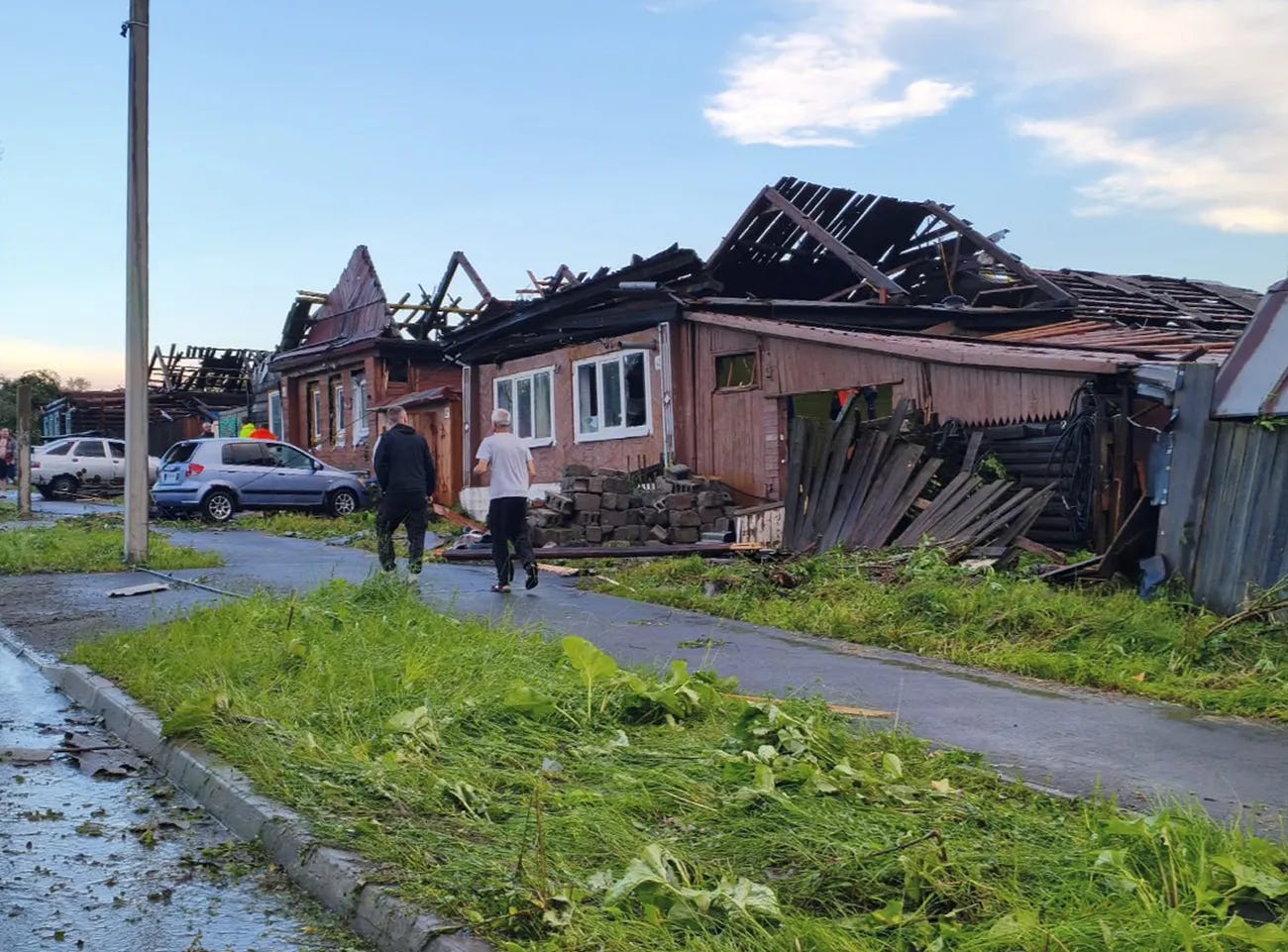
A rare tornado touched down in the city of Kushva in the Sverdlovsk region on Monday evening, causing mass damage. According to the Emergency Situations Ministry, 99 homes were damaged and 32 were destroyed entirely. 16 people were injured, and a temporary shelter was constructed for the victims of the disaster. “This is certainly a rare event,” local meteorologist Alexei Pulin said, “However, such tornadoes do occur once every few years in the Sverdlovsk region and surrounding areas.” (photo: 7x7)
Mobilization raids in Penza
Social media posts from the city of Penza suggest that the military recruitment office has been conducting mass raids in an attempt to boost mobilization. According to the Telegram channel “Govorit NeMoskva,” recruitment officers are searching for draft evaders and anyone of age who hasn’t yet registered for military service. Several local residents posted photos and videos of men being violently detained, and Govorit NeMoskva subscribers reported panic throughout the city. Artem Klyga, a member of the Movement of Conscientious Objectors, claimed that reservists were being rounded up and pressured into signing military contracts. “What we saw is alarming,” he said. According to local residents, men were being stopped indiscriminately while in their cars or on public transit. On June 18, officials set up military checkpoints throughout the city. Residents said that after men were detained at these checkpoints, they were sent to the military registration office and “harshly pressured” into signing contracts.
On June 19, the Penza regional Ministry of Internal Affairs responded to the allegations. It confirmed the raids but denied that anyone was being forced to sign military contracts. “The information contained in these posts is factually incorrect,” the Ministry posted on Telegram and VK, going on to say that local officials were looking for “individuals who have obtained Russian citizenship but failed to register for military service in a timely manner.” “These raids are routine operations conducted periodically across the region,” the Ministry said. Later in the week, Penza police claimed that “false information” was being spread online about the alleged recruitment raids. The agency threatened to prosecute anyone who was disseminating “unverified details” in accordance with Russian law.
Russian military mobilization has fallen sharply across the country, making it more difficult for regions to meet their recruitment quotas. According to Meduza, the Kremlin is reportedly considering a new wave of mandatory mobilization following September’s State Duma elections. One source said “something could start” as early as October, although a final decision has not yet been made.
— Sara Ashbaugh
Quickfire: Regions
The Communist Party (KPRF) will soon announce its candidates for this September’s State Duma elections. The Vedomosti daily published a leaked list this week showing several major changes from 2021. According to the leaked data, Khakassia Governor Valentin Konovalov, who successfully saw off an attempt by the governing United Russia party to unseat him in 2023 and has been locked in a conflict with the ruling party ever since, is going to be the second-placed candidate on the KPRF’s federal list behind party leader Gennady Zyuganov. The party will, however, pull several of its better-known regional political figures from their home regions (where they were deputies in single-mandate districts) and field them as candidates on regional party lists. Maria Prusakova, a prominent deputy from the Altai Territory, will head a macro-regional list in the Far East, while Oleg Mikhailov, a Komi Republic deputy, will be second-placed on a similar macro-regional list. Nikolai Bondarenko, a well-known politician and blogger from the Saratov Region, will run on the Udmurtia/Perm list. The rearrangements suggest that the party is trying to preserve its best known personalities but is also aware of its shrinking space in regional politics, especially after crackdowns against several regional party heavyweights over the past year.
The regional media outlet Siberian Express highlighted that, based on state procurement data, Bank Rossiya (a bank connected to Putin confidants Yury Kovalchuk and Gennady Timchenko, as well as one of Putin’s cousins) secured 33 contracts to lend to cities and regions in spring 2026. Notably, the bank lent to the Novosibirsk, Irkutsk, and Tyumen regions for the first time, three Siberian regions facing financial difficulties due to massive drops in their own revenues amidst disruptions to their dominant industries. This development is significant because, according to Treasury data, regional debt servicing costs more than doubled in the first four months of this year relative to the same period in 2025, after regions in deficit were forced to take out expensive loans from the market to plug holes in their spending. The Novosibirsk and Irkutsk Regions are among the largest contributors to this growth, along with other regions facing budgetary pressure, such as the Kemerovo and Nizhny Novgorod regions. Recent amendments to the Budget Code adopted at the federal level will once again make cheap treasury loans available to regions in fiscal distress. However, several regions have already started cutting spending on key public services.
— Andras Toth-Czifra

In this new report, FPRI Fellow Dr. Suzanne Loftus challenges the common narrative that time favors Russia in its conflict with Ukraine. Instead, Loftus highlights that Russia is suffering massive structural, economic, and geopolitical decline due to unsustainable military spending, historic casualty rates, and a reliance on transactional, weakening foreign partnerships. With Ukraine successfully leveraging technological innovation, deep logistical strikes, and an integrated Western coalition to inflict disproportionate costs, this report argues that time actually disadvantages Moscow. It urges the West to maintain its strategic patience and support rather than forcing a premature settlement.
By the numbers
55% - Putin’s approval rating prognosis for September 2026, according to slides presented by Ukrainian President Volodymyr Zelenskyy. This figure is based on Ukrainian intelligence work that exposed a non-public VTsIOM survey made for the Kremlin. The slides also suggest that Putin’s disapproval rating will climb to 33% and the rating of the governing United Russia party will be 22%. The documents suggest that the Kremlin is aware of the downward trend in the authorities’ real popularity amid growing war fatigue.
47-51% - New target benchmarks for the ruling United Russia party, according to the sources of the Vedomosti daily. This is down from the 55% benchmark that the party’s general secretary, Vladimir Yakushev, publicly stated in March. The paper notes that the target benchmarks were reduced in order to lower the risk of rigging, which would reduce the legitimacy of the official results amidst the ruling party’s falling popularity.
5.85% - annual inflation as of June 22. Rosstat data suggests that this is driven primarily by a 3% weekly rise in petrol prices and a 2.7% rise in diesel prices. The full effect of higher fuel prices due to the developing supply crisis has likely not been visible in CPI yet, especially as higher fuel prices are impacting agricultural production.
4% - the amount by which the Moscow Exchange (MOEX) decreased earlier this week, hitting its lowest level in more than three years. The benchmark MOEX index dropped to less than 2,368 points on Monday afternoon for the first time since March 2023. MOEX has been on the decline for almost 4 consecutive months and has lost more than 14% of its value since the beginning of the year. According to The Moscow Times, the Central Bank’s moderate key rate cut last week likely signaled to investors that higher borrowing costs are, at least in the short term, here to stay.
— Andras Toth-Czifra & Sara Ashbaugh