

Hungary for change?
An opposition party is leading in the polls ahead of Hungary's legislative elections



Here’s what you might have missed this week:
Pollsters predict major wins for the Respect and Freedom Party (TISZA) during Hungary’s legislative elections this weekend.
Major flooding has continued in the Republic of Dagestan, causing the Russian government to declare a state of emergency in the region.
Russia and Ukraine agreed to a temporary ceasefire for the Orthodox Easter holiday on Sunday.
— Sara Ashbaugh
Losing Hungary?
Hungary will hold a legislative election on Sunday, April 12. According to independent pollsters, this seems likely to result in the victory of the opposition Respect and Freedom Party (TISZA), ending the 16-year governance of the illiberal Fidesz party and its leader, Viktor Orbán. One pollster predicted a two-thirds supermajority for TISZA, which would allow the new government to change Hungary’s constitution and dismiss most high officials appointed by the current government. However, due to Hungary’s mixed and heavily gerrymandered electoral system, predictions remain difficult to make.
The race commands high interest for the Kremlin, as Orbán has long commandeered a foreign policy aligned with the Kremlin’s strategic interests. For example, Orbán has acted as a spoiler in the EU Council on matters related to sanctions and Ukraine and has served as one of the unofficial leaders of Kremlin-linked or Kremlin-aligned illiberal parties in Europe. His government also refused to expel Russian diplomats after the start of Russia’s full-scale invasion and denied a Russian intel op targeting the servers of the Hungarian Ministry of Foreign Affairs in 2021. According to wiretapped conversations between Foreign Minister Péter Szíjjártó and his Russian counterpart (and “friend”) Sergey Lavrov, as well as between Orbán and Vladimir Putin himself, the government regularly informed and coordinated with the Kremlin and the Russian Ministry of Foreign Affairs about EU discussions regarding sanctions and the war in Ukraine.
Prior to this year’s election, Orbán’s government built a propaganda campaign demonizing Ukrainians and accusing the Ukrainian government of meddling in favor of the opposition. To this end, they used secret service methods and also refused to repair the Druzhba oil pipeline, which was bombed by the Russian military. Meanwhile, recent reporting suggests that the GRU, Russia’s military intelligence, deployed a task force to help Orbán win the election and even suggested staging an assassination attempt (which was eventually rejected). On April 5, Orbán and the Serbian government announced that explosives were found south of the border of the two countries near the TurkStream gas pipeline carrying Russian gas to Hungary. The Hungarian Prime Minister hinted at Ukrainian involvement, while the opposition, along with Hungarian analysts, suggested that it was a false-flag operation. Other potential false flag operations may still be planned, especially given the several weeks-long transitory period between the election and the earliest date when the new government can be voted in by the new parliament.
Orbán’s defeat, which, according to Meduza’s Kremlin sources, is now considered a likely outcome in Moscow, would be a major loss for the Kremlin in European politics. However, its full significance will ultimately depend on two factors. First, it will depend on whether Fidesz loses in a way that leaves either Orbán (or a similarly Kremlin-friendly successor) with a relatively easy path back to power—as was the case with other Central European illiberal leaders who lost elections, such as Slovak Prime Minister Robert Fico or Czech Prime Minister Andrej Babiš—due, for instance, to a slim parliamentary majority for the incoming government and its resulting inability to remove Fidesz-appointed cadres and govern in a stable manner. Second, it will depend on how quickly and decisively a new government moves on issues of direct concern to the Kremlin, such as cracking down on Russian intelligence infrastructure in Hungary and opening investigations into corruption networks and cyber intrusions.
Péter Magyar, the leader of TISZA, campaigned on bread-and-butter issues and fighting corruption. He has only recently shown bolder opposition to the Russian government publicly, focusing on the alleged GRU involvement and the servility of the current government exposed by the leaked calls. Even so, TISZA’s program does not foresee Hungary giving up on Russian energy imports, only a diversification over the next decade and an audit of the Paks 2 nuclear power plant project led by Rosatom. Magyar has also carefully avoided centering the war in Ukraine in his public statements, and there is no indication that the new government would take a complete U-turn on the issue, even if it were to be altogether less disruptive in the EU Council and stricter on corruption (which is to be expected, given that much of the party’s promises rely on a new government being able to unblock EU development funds).
It is also worth noting that even without Orbán in office, Russia would retain other, albeit less direct, leverage points in the EU: illiberal parties across Europe nearing governance mandates, an ongoing sabotage campaign designed to exploit disillusionment with the state of public infrastructure, and centrist governments.
— Andras Toth-Czifra
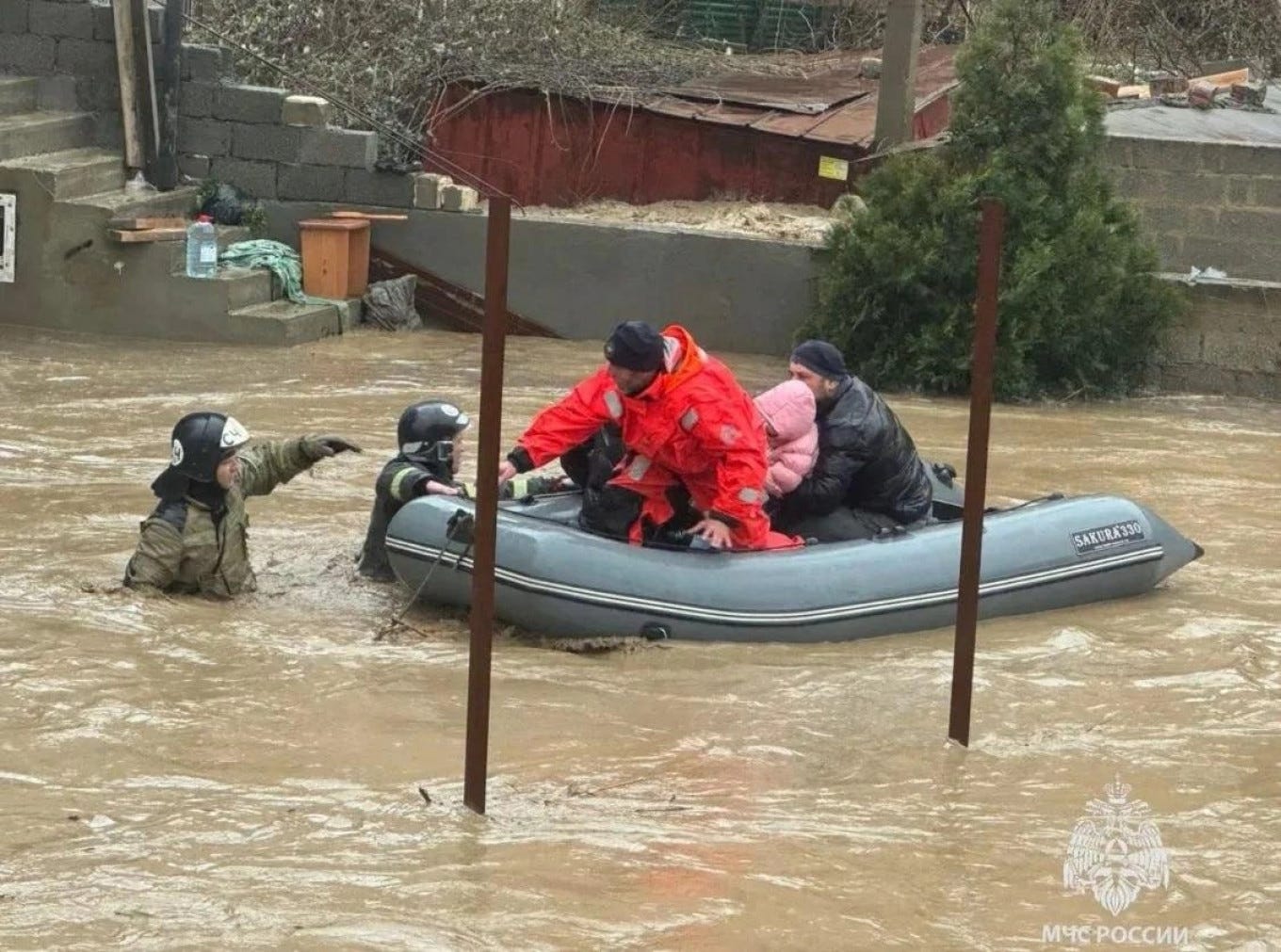
Two weeks of heavy rainfall have led to massive flooding in the Republic of Dagestan, with six people reported dead and thousands evacuated. On Thursday, the federal government introduced a state of emergency in the region, and rescue crews have been working tirelessly to help those trapped by the floods. More on this story below. (photo: Russian Emergency Situations Ministry)
Quickfire: Regions
Floods in the Republic of Dagestan intensified over the past week, triggering the introduction of a federal state of emergency. The disaster has officially claimed the lives of six people and affected tens of thousands, with more than 3,000 evacuated. The damage to agricultural land is still being assessed, especially with further torrential rain forecasted to hit the region in April and with a dam failure affecting a major irrigation canal in the region. The regional government’s initial damage estimate is 10 billion rubles. Funds for reconstruction will have to come from federal sources given that Dagestan is a highly subsidized region, relying on the federal budget for roughly two-thirds of its revenues. On the orders of Vladimir Putin, the disaster response is being led by Alexander Kurenkov, the federal Minister of Emergency Situations. Additionally, the floods have led to rumors about the imminent dismissal of Governor Sergey Melikov, who blamed the situation on property owners. The floods have also caused growing damage in other regions, including Chechnya, a neighbor of Dagestan, and the Siberian regions of Kemerovo, Omsk, Novosibirsk, and the Altai Territory.
Reports from several regions suggest reduced or delayed wages for public employees after the first months of the year saw the continuation of severe fiscal shortages in many Russian regions. Tuva Governor Vladislav Khovalyg acknowledged systematic problems with salary payments to teachers in the Republic, becoming at least the eleventh region in the past months to experience such delays. In the Kemerovo Region, which is entering its third year of severe fiscal problems, schools are reportedly planning to cut premiums paid to teachers from next month on, after the region’s budget registered a deficit widening beyond fiscal plans in the first three months of the year. The region previously cut its expenditures on education by a fifth in its 2026 budget. Wage arrears and staff cuts affecting state-owned organizations and public institutions have also been reported from the Altai Territory and the Novosibirsk Region.
— Andras Toth-Czifra
Easter ceasefire
Russia and Ukraine agreed to a temporary ceasefire for the Orthodox Easter holiday this weekend. On Thursday, the Kremlin announced that there will be a pause in fighting from Saturday afternoon through Sunday evening, adding, “We assume that the Ukrainian side will follow the example of the Russian Federation.” Ukrainian President Zelenskyy also confirmed the ceasefire, posting on X, “People need an Easter free from threats and real progress toward peace, and Russia has a chance to avoid returning to hostilities after Easter.”
Zelenskyy was the first to propose the idea of a ceasefire during Easter. He suggested a moratorium on strikes against energy infrastructure for the holiday weekend, saying, “If Russia is ready to stop strikes on our energy infrastructure, we will be ready to respond in kind.” The Kremlin initially dismissed this proposal, claiming it was too vague. “We don’t see any clearly articulated initiative for an Easter ceasefire based on Zelenskyy’s statements,” Kremlin spokesperson Dmitry Peskov said. Now, however, Russia has assented to the temporary truce, although it still maintains that its troops are “prepared to counter any possible provocations by the enemy.”
Russia unilaterally declared a ceasefire during the Easter holiday last year, which both sides accused each other of violating. Ukrainian soldiers interviewed by the BBC remained skeptical that this year’s ceasefire will be any different.
— Sara Ashbaugh
Russia’s Drone Line Experiment
By Rob Lee and Dmytro Putiata
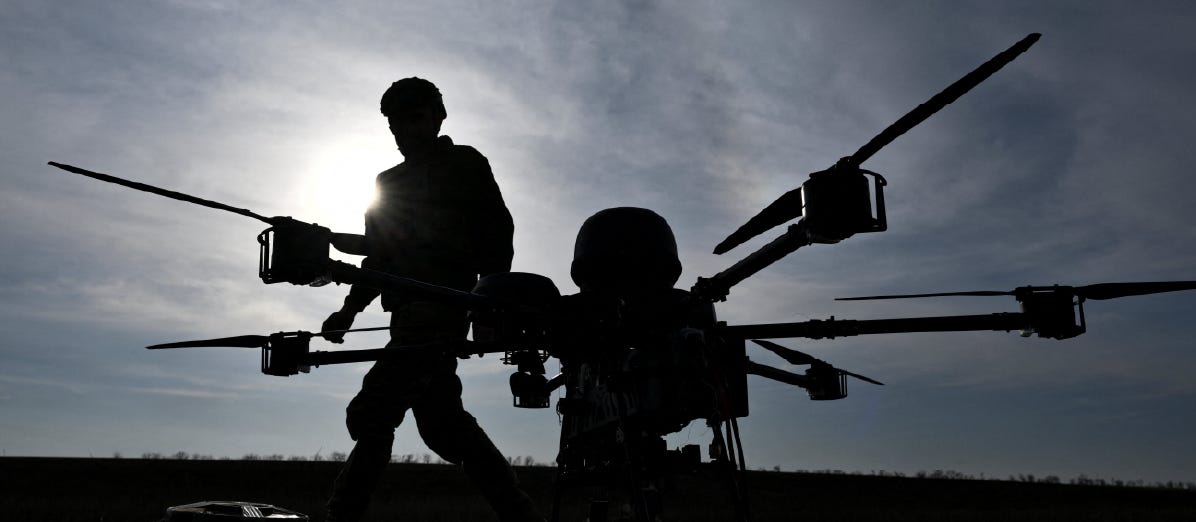
The Russian military has continued to experiment with improving its employment of uncrewed aerial systems (UAS) in support of its maneuver forces.
Both Russian and Ukrainian forces face coordination challenges and internal debates regarding the “ownership” of different depths of the battlespace and the command-and-control relationship between independent drone units and ground commanders.
While Ukraine typically leads in initial technological innovation, Russia has proven effective at copying these advancements and scaling them through systemic experiments across various military districts.
Despite narrowing the capability gap in 2025 through new employment concepts and elite units, Russian advancements have failed to produce a decisive military breakthrough.
For more from Rob and Dmytro, subscribe to Two Marines, a newsletter on Russia’s war in Ukraine, defense technology, and modern warfare.
By the numbers
4.576 trillion rubles - Russia’s federal budget deficit in the first three months of the year. This is significantly higher than the deficit foreseen for the whole of 2026 (3.78 trillion). According to the Finance Ministry, the deficit, which is also 2.6 trillion rubles bigger than at the same point last year, reflects the advance financing of certain contracts. However, the federal budget has not yet registered its windfalls from the oil price boom triggered by the U.S.-Israeli war on Iran. These windfalls should lead to a narrowing of the budget gap in April despite increased spending, even as Russia’s main oil exporting ports continue operating below capacity.
95% - the blocking rate of the Telegram messaging and information sharing app across Russia as of April 10, according to the OONI international monitoring project. Over the past week, the Russian authorities have ramped up restrictions on the app as an initial cohort of regional leaders moved their communication over to the government-controlled MAX messenger. The Telegram ban has led to protests and rare public criticism, even from the administrative elite.
14 years - the prison sentence of former Kursk Governor Alexey Smirnov in a corruption case regarding kickbacks he received during the construction of defensive fortifications in Kursk prior to Ukraine’s 2024 incursion. Smirnov’s deputy, Alexey Dedov, was sentenced to 17 years. Smirnov previously stated that his predecessor, Roman Starovoit (who committed suicide last year), was at the top of the corruption chain.
$116 - the price per barrel of Urals crude oil last week, the highest it has been in more than 10 years, according to reporting by Bloomberg. This is a 230% increase over the past four months—the price was only $40 per barrel in December. The war in Iran has affected global oil supply, resulting in higher overall oil prices. Additionally, in March, the U.S. issued a temporary sanctions waiver on the purchase of Russian oil and petroleum products. Russia has benefited from the higher global oil prices and will use the windfall revenue to shore up its federal budget.
— Andras Toth-Czifra & Sara Ashbaugh