

Impending Duma
The United Russia party names its candidates for the State Duma elections


Here’s what you might have missed this week:
The United Russia party named its candidates for the State Duma elections, including a number of war participants.
To address the ongoing fuel crisis, Russia is considering additional gasoline imports from allies like Kazakhstan and India.
The Penza Region, the Irkutsk Region, and the Transbaikal Territory all declared states of high alert in response to the fuel crisis.
— Sara Ashbaugh
A sense of impending Duma
The governing United Russia party held its electoral congress on June 28, naming the party’s candidates for the September Duma elections. While it is guaranteed that official data will show the party’s victory in September, the congress was nonetheless an important political moment, as the candidate list and the speeches reflect the direction that the authorities want the party’s communication to take under the current domestic circumstances. Polls published in the weeks leading up to the congress saw United Russia’s popularity drop significantly and the overall public mood worsen on the heels of severe internet restrictions and an ongoing fuel crisis.
The party’s federal list will be headed by Foreign Minister Sergey Lavrov and Moscow Mayor Sergey Sobyanin, but also contain figures deeply associated with the war against Ukraine, such as war blogger Yevgeny Poddubny and children’s ombudsman Maria Lvova-Belova, who is wanted by the ICC for her role in the kidnapping of thousands of Ukrainian children. Sobyanin’s inclusion is likely both a nod to voters who are tired of the war (the mayor is not one of its enthusiastic supporters) and an attempt to use Sobyanin’s genuine popularity as an asset. 76 war participants will also run as candidates, and Vladimir Putin, speaking at the party’s congress, once again named military personnel the “new elite.” 55 governors will lead regional lists, making regional administrators personally interested in increasing the vote tally of the ruling party. United Russia also changed more than half of its candidates in single-mandate districts compared to the last election in 2021, most of them in Moscow and in industrial regions that have experienced economic decline over the past year.
The elections will be held over three days (September 18-20) and in 33 regions, mostly in the Northwest and along the Urals industrial belt, where there are major urban centers and where the ruling party’s popularity has been low. The authorities will use online and electronic voting, both of which have been shown to facilitate rigging. Moreover, over the past months, the authorities have put pressure on “systemic” opposition parties, especially the Communist Party (KPRF), whose more active regional chapters also faced pressure from law enforcement. In the latest twist, a court blocked the KPRF from holding its candidate nomination conference in the Tver Region following a lawsuit from three expelled members. This raises the possibility that the Communist Party will not be able to nominate candidates for regional elections.
Putin’s congress speech contained many panels seen earlier (e.g. about the collective West trying to undermine Russian elections, an attempt by Putin to assign blame for interruptions in advance and justify restrictions), but its most important message was that the elections would be held according to initial plans. Over the past week, rumors surfaced about the security elite pushing for the elections to be postponed or called off due to the growing volatility of the domestic political situation. They allegedly proposed using the state of high alert—which three regions have introduced due to fuel shortages—as a pretext. It is worth noting that there was a similar dilemma in 2022 to postpone the (regional) elections, but they were eventually held. Putin’s statement signals the Kremlin’s position now, but this may still change before September.
— Andras Toth-Czifra
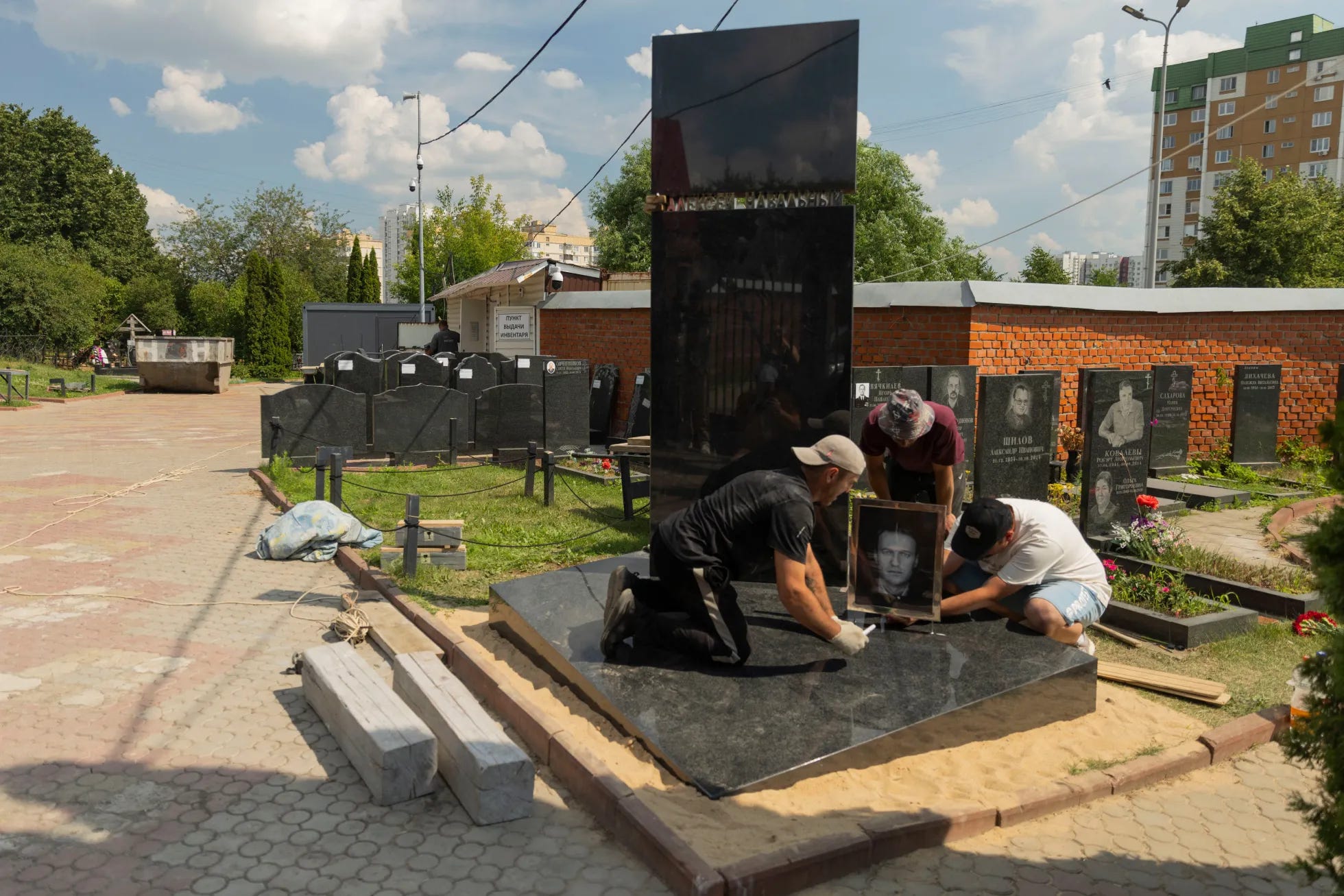
A monument to the late opposition leader Alexei Navalny was erected at his gravesite in Moscow’s Borisovskoye Cemetery this week. Navalny’s family held a competition to decide the monument’s design, choosing this design out of more than 250 submissions. Navalny’s parents and many of his supporters visited his grave during the monument’s installation, but his wife and children remain in exile abroad. Navalny died under suspicious circumstances in a Siberian penal colony on February 16, 2024. (photo: Alexandra Astakhova / Mediazona)
Russian gas imports
Ukrainian drone strikes on Russian oil refineries have continued to exacerbate Russia’s ongoing fuel crisis. Russian gasoline production is significantly diminished, with refining capacity down almost 30% compared to previous years, according to some estimates. Vladimir Putin even acknowledged the crisis during a meeting with several high-ranking energy officials in the Kremlin on Sunday. “Overall, to stabilize the fuel market, systemic steps must be taken that are consistent with the scale of current challenges,” he said. According to Putin, Russia’s gasoline reserves are currently at 1.7 million metric tons—a 4% decrease year-over-year.
In response to the crisis, Russia is reportedly turning to allies to boost its gas imports. On Tuesday, the Kremlin confirmed that it is pursuing supplemental import contracts in order to meet the demand for fuel and work toward “market stabilization.” Russia has increased its gasoline imports from Belarus, and Reuters reported last week that Russia is in talks with Kazakhstan to purchase 50,000 metric tons of gasoline. However, Kazakhstani Energy Minister Erlan Akkenzhenov said that Russia had not yet formally requested the supplies. According to industry sources quoted by Reuters, a shipment from India with 60,000 metric tons of gasoline from Indian refiner Nayara Energy is already en route to Russia. Indian Oil Minister Hardeep Singh Puri denied that any Indian companies are selling gas to Russia, but he said that it was “possible” that Russia bought Indian-origin fuel via traders. India is Russia’s largest crude oil importer, purchasing a record-breaking 2.66 million barrels per day from Russia in June.
Meanwhile, on Thursday, Russian Prime Minister Mikhail Mishustin signed a decree authorizing the sale of Euro-3 gasoline, a lower-grade gasoline, through the end of 2026. This “preventative measure” is intended to “improve fuel supply reliability,” the decree states.
— Sara Ashbaugh
Quickfire: Regions
Three regions—the Penza Region in Central Russia, the Irkutsk Region in Siberia, and the Transbaikal Territory in the Far East—declared states of high alert due to the developing fuel crisis. This allows governors and operational headquarters to take more direct control over fuel distribution in their regions. The situation remains the worst in occupied Crimea and adjacent Russian regions. As of the beginning of July, fuel disruptions have been reported from the vast majority of Russian regions, with a growing number of restrictions on sales. After Vladimir Putin himself acknowledged problems on the domestic fuel market, the federal government’s main policy response has been to import fuel from third countries (a shipment was reported from India) and permission to sell lower-grade fuel. The effects of the crisis are meanwhile increasingly felt in the everyday functioning of public services that rely on fuel-powered vehicles, such as waste collection, ambulances, and public transportation. This will also put further burden on regional budgets, as it is where operators will first turn for financial assistance. Diesel shortages also threaten the harvest season, and fuel price increases will likely bleed over to food prices and secondary products in the fall.
Confirming earlier rumors, Vyacheslav Gladkov, the former governor of the Belgorod Region, was appointed Russia’s envoy to the Russian-occupied Georgian region of Abkhazia. The appointment is seen as a demotion for Gladkov and a signal to other governors in the country. The Belgorod governor resigned in May 2026 after more than five years in office, after several regional officials were investigated for corruption involving the region’s defensive fortifications, even though he had previously expressed willingness to continue serving as regional head. Gladkov was seen as a competent communicator and a genuinely popular head of a border region. He nonetheless came into a conflict with the security elite over the increasingly severe internet restrictions, which he openly criticized. This was widely seen as the real reason for his de facto dismissal and subsequent demotion, signaling the growing sway of the security elite over regional political appointments and dismissals, as opposed to the corporate-style evaluation system championed by the Kremlin’s domestic policy block. Alexander Bogomaz, the governor of the Bryansk Region who resigned at the same time as Gladkov under similar circumstances (but without a conflict with the security services), received a mandate in the State Duma.
— Andras Toth-Czifra
You might be interested in…
Rob Lee, FPRI Senior Fellow and co-host of the Ukraine Military History Podcast, speaks with Sam Cook after another round of frontline visits—from Zaporizhzhia to Donetsk to Kharkiv—talking directly with frontline commanders and the R&D teams building the war's newest capabilities. The two discuss what's actually changed as of early June 2026 and why he wouldn't be surprised to see successful Ukrainian armor assaults this year.
By the numbers
2-3% - the predicted drop in investments this year according to German Gref, the head of Sberbank, if the Central Bank does not accelerate its key rate-cutting. Gref’s statement is the latest in a series of signals from the business elite that they are increasingly dissatisfied with the Bank’s monetary policy. Many are afraid that the inflationary pressure triggered by the fuel crisis could result in the Central Bank cutting rates even slower or reversing its policy course.
50.3 - Russia’s manufacturing PMI in June according to S&P Global, up from 48.8 in May. This is the first reading over 50 points in more than a year. However, it does not necessarily reflect stable growth expectations beyond the stabilization of orders, S&P remarks. S&P also noted that export orders fell in June at the sharpest rate since September 2025. Manufacturing production growth is almost entirely carried by the defense sector, and year-on-year GDP growth was merely 0.3% in May.
500 million rubles (6.4 million USD) - the amount seized by law enforcement officials from Sergey Gaida, a former deputy housing minister of the Sverdlovsk Region, and Vadim Pilnikov, the mayor of Degtyarsk. Gaida oversaw housing and utilities in the region. He is accused of regularly soliciting bribes for awarding municipal contracts. The asset seizure is just the latest in a long series of corruption cases involving regional officials, many of whom oversaw the same area.
60% - the percentage of Russians who believe that the economic conditions in their area are getting worse, according to a new Gallup poll. As Gallup notes, this is the first time since 2006 that the majority of Russians believe the economy is deteriorating. The poll, which was conducted from March to May, also reported that 56% of Russians believe living standards are getting worse and 58% say it’s a bad time to find a job.
30% - the increase in gas prices in occupied Sevastopol from June 23 to 29, according to Rosstat’s official weekly fuel price data. Other sources suggest that the actual price increase may be even higher. Rosstat also reported an overall gas price increase of 1.6% and a diesel fuel increase of 2.2% across Russia over the same period. On June 29, the average consumer gas price was 72.38 rubles per liter and the average price in Sevastopol was 118.79 rubles per liter.
— Andras Toth-Czifra & Sara Ashbaugh
“Impending Duma” may be the best title I’ve seen in years. Brilliant!