

Mind the gap
New analysis of the Russian federal budget shows a widening deficit



This week in the news:
New economic analysis suggests that the Russian federal budget deficit may widen to as much as 3.5% of GDP by the end of this year.
Putin traveled to India last week for the 23rd Russia-India Summit, where he discussed defense and trade ties with Prime Minister Narendra Modi.
The Russian government announced their new health care development strategy, reflecting significant wartime limitations.
— Sara Ashbaugh, Editor in Chief
Plans to lift a sagging economy
Fresh figures on the execution of the federal budget in the first 11 months of the year, published last week, show a widening deficit: 4.3 trillion rubles, or 2% of GDP. The official expectation is that this will grow to 5.7 trillion, or 2.6%, by the end of the year. However, based on historical data, researcher Janis Kluge suggested that the real figure could be closer to 3.5%. Oil- and gas-related fiscal revenues have remained significantly below last year’s figures (22.4%), while expenditures were 12.5% higher than in 2024.
Meanwhile, a Kremlin-aligned think tank, the Center for Macroeconomic Analysis and Short-Term Forecasting (TsMAKP), warned in a report that due to the growing share of bad loans in banks’ portfolios—2.3 trillion rubles as of November—there is a possibility of a banking crisis in 2026 if the share of non-performing assets in the system exceeds 10%. The situation is even more concerning in the consumer loan sector. The Central Bank earlier proposed stricter borrowing requirements but also tried to communicate that it did not see an immediate threat of bank runs.
Worsening economic perspectives were on the agenda of the Council for Strategic Development and National Projects, which Vladimir Putin chaired this week. At the meeting, the President required that the government “immediately begin” implementing a structural reform plan to bring Russia’s growth rates in line with global growth and create “comprehensive” growth across all regions of the country. Based on his speech, the President seems to think that Russia can unlock higher growth (and revenues) by reducing illegal employment, increasing government control over cash circulation, and tax collection. Apart from adopting regulations to this effect, the government also aims to tighten legislation on consumer loans and hidden employment. Additionally, the government is hoping that lower interest rates planned for next year will improve growth prospects. Putin will meet with the Russian Union of Industrialists and Employers after December 19, when the Central Bank adopts its next rate decision.
However, there was no talk about a massive refocusing of federal budgetary expenditures on domestic development projects or plans to improve the business climate. This year, several regions have been struggling with their finances and have had to cut expenditures due to consistently high spending on social aid and local economies, while crises affecting their dominant industries (especially extractive industries and metallurgy) have sharply reduced incomes—a warning sign that foreshadows potentially more similar crises in 2026.
— Andras Toth-Czifra
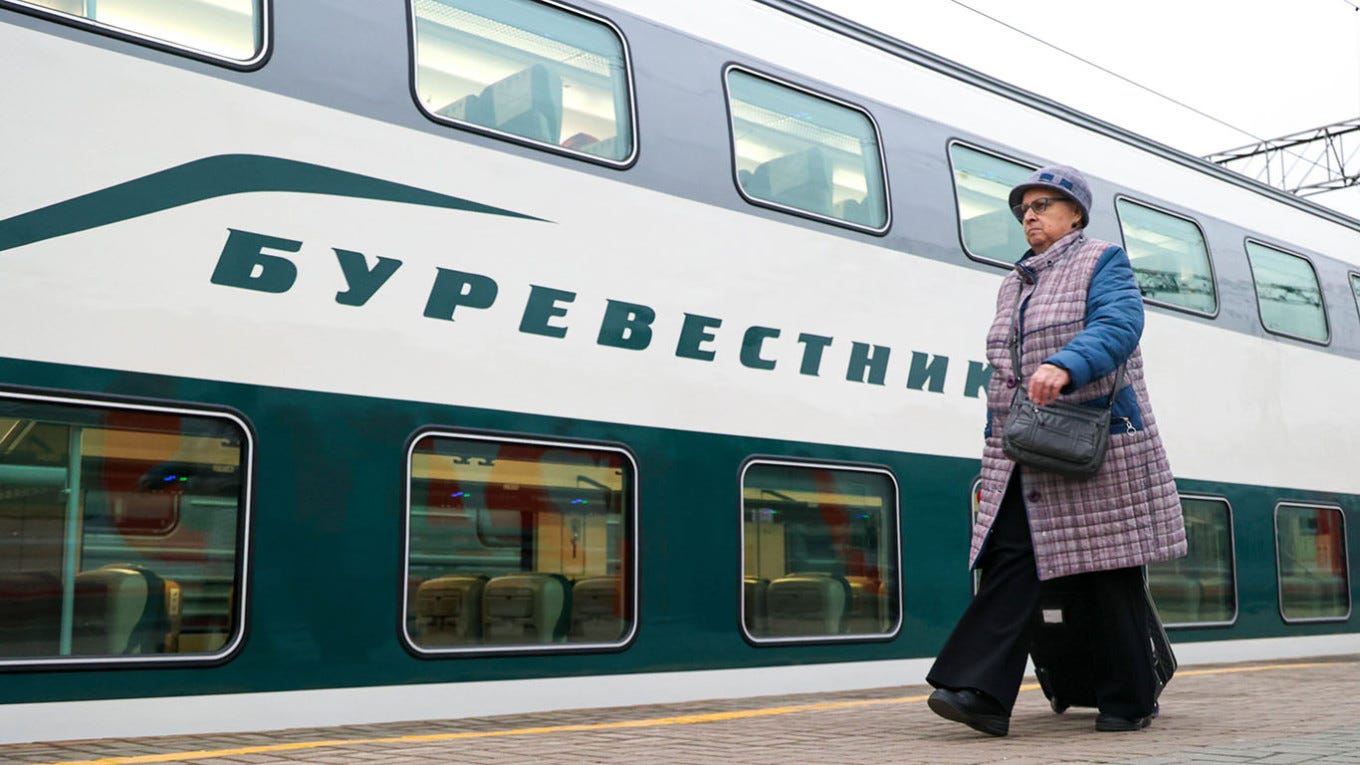
Russian Railways (RZhD) launched a new series of high-speed double-decker passenger trains that run between Moscow and Nishny Novgorod this week. The new trains are named Burevestnik (Storm Petrel) after a RZhD service from the 1960s. The 10-car trains carry up to 730 passengers each and take about 4.5 hours for a one-way journey. “Given the train’s capacity, we believe that traffic volumes will undoubtedly increase,” RZhD Deputy Managing Director Ivan Kolesnikov said during the unveiling ceremony at Moscow’s Yaroslavsky Station. The Burevestnik trains are part of RZhD’s fleet modernization, which has also seen double-decker trains that run from Moscow to St. Petersburg, Kazan, Voronezh, and Samara. (photo: Yaroslav Chingaev / Moskva News Agency)
Russian-Indian bilateral relations
President Putin traveled to India last week for the first time since 2021. He attended the 23rd Russia-India Summit on Friday, where he discussed Russian-Indian defense and trade ties with Prime Minister Narendra Modi. Putin arrived in New Delhi the day before the summit accompanied by seven ministers, including Russian Defense Minister Andrei Belousov.
Following the summit on Friday, Putin and Modi announced that they had finalized Russia and India’s economic cooperation program, which involves increasing annual trade to $100 billion by 2030. Bilateral trade totaled $68.7 billion at the end of the previous fiscal year, although Indian exports only made up $4.9 billion of this amount. “To achieve this significant goal, a program for the development of Russian-Indian economic cooperation until 2030 has been agreed upon,” Putin said. Energy ties were also on the agenda, with Putin noting that Russia is ready to “continue ensuring the uninterrupted supply of fuel for the rapidly growing Indian economy.” In 2024, almost 36% of India’s total crude oil came from Russia.
The U.S. has already penalized India for its close relationship with Russia, imposing a 50% tariff on imported Indian goods. India is one of the top two buyers of Russian oil (along with China), and although it scaled back some of its planned purchases after the announcement of new U.S. sanctions on Rosneft and Lukoil, trade with India remains a significant source of income for Moscow. Indian Foreign Secretary Vikram Misri told reporters after last week’s summit that India would maintain its trade relationship with Russia. “We are continuing our cooperation between the two countries,” he said.
According to Indian officials, Putin and Modi also discussed the delivery of the remaining S-400 surface-to-air missile defense systems that Russia agreed to sell to India in 2018 for approximately $5.4 billion. India has already received three of the five systems and is awaiting the final two. The two countries also plan to scale up their defense cooperation in other ways. This includes India manufacturing parts for Russian defense equipment, such as parts for MiG-29 fighter jets. In February of this year, India and Russia signed the Reciprocal Logistics Support (RELOS) Agreement, which includes logistics and dispatch parameters for the movement of troops and military equipment between the two countries. Last Tuesday, the State Duma ratified RELOS ahead of Putin’s trip to India.
Moving forward, it may be a challenge for India to maintain its diplomatic relationships with both the U.S. and Russia, Praveen Donthi, a senior analyst with the International Crisis Group, told AP. “The significant change now is [India’s] desire to be a strategic partner with the U.S. at the same time, which will be a diplomatic challenge,” he said.
— Sara Ashbaugh
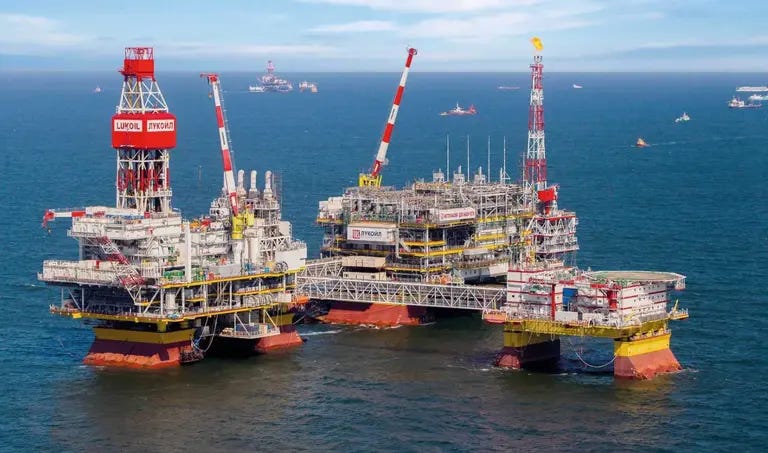
On Thursday, Ukraine claimed to have carried out a drone attack on Russia’s Filanovsky oil platform in the Caspian Sea, pictured here. According to the Ukrainian Security Service (SBU), four Ukrainian aerial drones hit the Lukoil-operated oil rig earlier this week, disrupting output in more than 20 wells. “This is Ukraine’s first strike on Russian infrastructure related to oil production in the Caspian Sea,” an anonymous SBU source told CNN. Neither the Russian Defense Ministry nor Lukoil have confirmed the attack, although the Ministry reported downing one drone over the Caspian Sea on Monday. The rig, which started production in 2016, has a total capacity of 120,000 barrels of oil per day. (photo: Ukrainian Security Service)
Health care strategy
The government decreed Russia’s new health care development strategy, which reflects wartime limitations on Russia’s health sector. The 24-point document instructs the government to adopt an action plan to ensure, among other things, that the technological independence of the health care sector reaches 80% by 2030 and up to 90% of essential medications and 40% of essential medical products are produced in Russia.
The strategy focuses on “technological sovereignty,” an overarching goal that the Russian government has used in several fields to justify policy, especially over the past three years. In the case of pharmaceuticals, there is a real and pressing problem that the government has been unable to address. Following the adoption of sanctions against Russia in 2022, domestic production and alternative import channels have not been able to meet demand. In 2024, according to a Novaya Gazeta investigation, Russians lost access to 134 life-saving drugs, including cancer drugs, HIV drugs, and insulin for pregnant women. Meanwhile, federal budgetary spending on health care development has been slashed in real terms in the 2026 budget, making it questionable whether the government will be able to put money behind its ambitious goals.
This is not the only issue with the development of the health care system. Health care spending in consolidated regional budgets, which provide funding for the upgrading and expansion of regional hospital networks and the retaining of medical personnel, was still lower in 2025 in real terms than in 2021. A 2025 report by To Be Exact, a data analysis project, found large discrepancies in healthcare accessibility between poorer and wealthier regions. According to the government’s own estimates, in 2025 there was a shortage of 23,300 doctors and 63,500 mid-level medical personnel. This foreshadows potentially significant pressure on the system in the event of hundreds of thousands of war participants returning to the country.
— Andras Toth-Czifra
You might be interested in…
FPRI Senior Fellow Rob Lee interviews Colonel Serhii Shatalov, Commander of the 37th Marine Brigade
Quickfire: Regions
The State Duma and the Federation Council passed a long-discussed and disputed law this week allowing clear-cutting near Lake Baikal, the world’s deepest freshwater lake. The law permits sanitary logging in the lake’s so-called “central ecological zone,” as well as building new infrastructure along the shore of the lake (which has so far been prohibited). New infrastructure is subject to approval by a commission that will encompass officials and security officers. The bill has been on the agenda for several years and has caused an uproar both in the regions surrounding the lake and in scientific and ecologist communities, with even some United Russia deputies voting against it in the Duma. In September, scientists warned the Kremlin that the bill posed an ecological danger to Lake Baikal, while legal experts questioned whether the terms defined in the law would be able to restrict more extensive logging. The law may open the possibility of industrial development near the lake. Over the past decade, such projects have triggered some of the largest regional protests, including near Baikal. In Buryatia, Communist politicians have held protests against the law.
Criminal cases against prominent opposition figures continued this week. Тhe authorities opened a third criminal case against Pskov politician Lev Shlosberg, the deputy head of the liberal Yabloko party. He was arrested once again for two months, just as his previous house arrest for “discrediting the army” was about to expire (this is a tactic often used by the Russian authorities). This time, Shlosberg is accused of “spreading fakes about the army.” Shlosberg was also added to the list of “terrorists and extremists,” which will cause major difficulties in his day-to-day life and likely also for the functioning of his party. In Moscow, another prominent opposition politician, Ilya Yashin, was sentenced in absentia to one year and ten months in prison for not following rules set for “foreign agents.” Another court in the capital sentenced former Khabarovsk Governor Sergey Furgal, whose 2020 arrest unleashed a wave of protests in the region, to another 25 years in prison in a case involving the embezzlement of assets of a local bank. Furgal is already in prison after receiving a 22-year sentence two years ago in another case involving the murder of two businessmen in the early 2000s.
The Russian government will no longer fund monthly payments to Kursk Region residents who lost their homes during the Ukrainian army’s 2024-2025 incursion into the region. Governor Alexander Khinshtein, who met with Vladimir Putin over the past week, announced that the government would reallocate the funds to other support measures aimed at reconstruction and economic stimulus. Earlier, Putin agreed to continue the payments until people could return to their homes. Residents of the Korenevsky District are planning to appeal to the President. Following the announcement, Kursk residents started protesting, demanding that the government continue the 65,000-ruble monthly payments introduced only in February of this year, six months after the initial incursion. Earlier, residents held similar protests when the payment of aid suffered delays. However, this time, it appears that the local authorities are cracking down on the protesters. The episode highlights the limits of the federal government’s willingness to aid citizens directly suffering from the effects of the war for an extended period of time.
The government of Bashkortostan is reportedly planning to sell about a quarter of its shares in the Bashneft oil company in order to plug a growing gap in the region’s budget. Bashkortostan currently holds 25% in the company, which is majority owned by the state-owned Rosneft. The region, similarly to many other Russian regions, faces a growing fiscal deficit next year due to persistently high spending needs on social and economic policy, while facing a declining stream of its own revenues. (Bashkortostan has also faced the largest amount of confirmed military casualties among Russian regions, which puts further burden on regional finances.) Regions have little control over most of their revenue streams, and most of those facing financial difficulties have turned to raising regional taxes (e.g. transit tax) or cutting non-essential expenditures. Only in rare cases, such as Bashkortostan’s, do regions have adequate reserves or access to lucrative assets to sell. The fact that Bashkortostan is considering a sale like this suggests significant concerns about the stability of the regional budget.
— Andras Toth-Czifra