

More profit, more problems
The Russian government may impose a new excess profit tax



Here’s what you might have missed this week:
The Russian government will likely impose a new 20% excess profit tax on businesses to address the growing federal budget deficit.
Police raided Novaya Gazeta’s editorial office in Moscow last Thursday and arrested investigative journalist Oleg Roldugin.
Hundreds of workers in the Far Eastern Khabarovsk Territory staged multi-day protests over unpaid wages.
— Sara Ashbaugh
Taxing more and more
The federal government is reportedly moving ahead with a proposal to collect a new 20% excess profit tax from businesses in order to reduce the growing deficit in the federal budget. According to sources quoted by Interfax, the government will calculate the difference between the companies’ profits last year versus their average profits from 2018 and 2019. The details have not been finalized yet, but, in its current form, the surtax would be higher than a previous tax on extra profits from 2021-2022 that the government levied in 2023 when the federal budget was, as it is today, suffering from a shortage of revenue amidst rapidly growing military expenditures. Previously, companies in the metals, mining, and trading sectors that were targeted by the tax were able to reduce the 10% tax burden by half if they chose to pay it early.
It is unclear which sectors will be taxed this time given that both coal mining and metallurgy have been going through a crisis over the past year. It is also unclear whether the government will allow companies to reduce their tax burden. The Finance Ministry has not commented publicly on the decision, but President Vladimir Putin tasked the government with presenting a proposal by April 10. The Kremlin is also expecting oil and gas revenues to grow (by around $9 billion, according to Reuters) in April when the first gains from the closure of the Strait of Hormuz are realized. Meanwhile, the president reportedly instructed business leaders to make voluntary contributions to the federal budget in order to allow the Kremlin to spend more money on the war in Ukraine. This indicates, as the World Bank pointed out, that even the expected extra income will not be able to completely make up for the losses of earlier months and the government’s increased spending in the first quarter of 2026. The Kremlin is finding the economy’s performance alarming enough for Putin to demand urgent action from the Central Bank and the federal government for the second time this month.
The situation is also different from 2023 in the sense that the Kremlin has pushed through two rounds of tax hikes since then. In 2024, corporate income and personal income taxes were raised, and in 2025, the government adopted a VAT hike and tax hikes for small businesses. The explicit promise was that the tax system would be stable until at least 2030. Therefore, the introduction of a new tax could exacerbate tensions between the authorities and the business elite.
— Andras Toth-Czifra

St. Petersburg authorities recently approved a plan to renovate the historic imperial stable house in the city center. The complex, known as Konnyushennoye Vedomstvo, was established in the 18th century under Peter the Great. Now, the architecture firm Studio 44 has been approved to restore the structure, eventually converting it into 60% public spaces and 40% dining areas. The rendering of the courtyard pictured here shows Studio 44’s vision for the project. Work is expected to begin by the end of this month, initially focused on demolition and structural reinforcement. (photo: gov.spb.ru)
Novaya Gazeta office raided
Russian security forces raided the Moscow editorial office of the independent news outlet Novaya Gazeta last Thursday, culminating in the arrest of investigative journalist Oleg Roldugin. According to Novaya Gazeta, masked officers began the raid at noon on April 9, and it lasted more than 13 hours in total. Roldugin’s home was also searched before he was detained, with a court later formally authorizing his arrest. He stands accused of the illegal use, transfer, or storage of personal information—part of a larger case initiated by the Ministry of Internal Affairs. According to the Ministry, Roldugin allegedly belonged to a group that illegally accessed personal data in order to publish “negative content regarding Russian citizens.” Reporting by the BBC Russian Service suggests that Roldugin may have been part of an anonymous Telegram channel called “More Than a Fact.” This channel has almost 35,000 followers and has posted, among other things, information about the private flights of individuals like Dmitry Medvedev, Alexei Mordashov, and Vladimir Yevtushenkov.
During a hearing last week, Moscow’s Tverskoy District Court ordered that Roldugin be held in pretrial detention until May 10. He pleaded not guilty to the charges, and his lawyer, Marina Andreyeva, said she has not yet been told whose personal information he allegedly obtained. If convicted, Roldugin could face up to four years in prison. Meanwhile, Novaya Gazeta confirmed that its other editorial staff are continuing their work. “We will keep you updated on the case against Oleg Roldugin as much as possible,” the outlet posted on Telegram.
The same day that Novaya Gazeta’s offices were searched, the Russian Supreme Court designated the human rights group Memorial as an “extremist organization,” banning it from operating in Russia. The move was widely criticized by activists and journalists, including freelance journalist Vladimir Sevrinovsky. “Having driven all influential opposition media out of the country, the authorities have clearly set a course in recent months to silencing the few remaining voices, who are almost inaudible,” he said.
— Sara Ashbaugh
Quickfire: Regions
Hundreds of workers from the Chinese contractor Petro-Hehua staged multi-day protests over unpaid wages in Komsomolsk-on-Amur, a city in the Far Eastern Khabarovsk Territory. The workers marched through the city and held sit-ins, appealing to both Vladimir Putin and Rosneft CEO Igor Sechin; Petro-Hehua had been working on a unit of a Rosneft-affiliated refinery before the contract was cancelled over delays. The authorities deployed Rosgvardiya and OMON riot control troops against the protesters, while China’s consulate in the city was involved in negotiations. As the incident highlights, the issue of wage arrears—which has become more prominent and widespread over the past months in sectors such as road construction, mining, and the public sector—may be spreading even into companies adjacent to the oil sector. It also shows the increasing footprint that Chinese businesses have in the Russian Far East. Additionally, it is worth noting that there have been speculations that it was Sechin’s idea for large Russian employers to make voluntary contributions to the federal budget.
Amidst rumors of his imminent dismissal, the governor of the Belgorod Region, Vyacheslav Gladkov, went on a two-week leave this week. The governor is likely staying under the radar until the Kremlin makes a decision about his future. Gladkov has been one of Russia’s most media-savvy governors over the past years. He also used to have a good working relationship with the security services, important for his ongoing project of dismantling the power structures solidified under his predecessor, Yevgeny Savchenko. More recently, however, he has spoken out against internet restrictions and attempts to ban the Telegram messaging service, which he argued complicates the defense of his region bordering Ukraine. For the past month, several news reports speculated about Gladkov’s dismissal or promotion to a federal position—usually a sign of active lobbying in Moscow—and suggested that his potential successor could be Alexander Shuvaev, a major general and Ukraine war participant from the region.
— Andras Toth-Czifra
Russia’s Drone Line Experiment
By Rob Lee and Dmytro Putiata
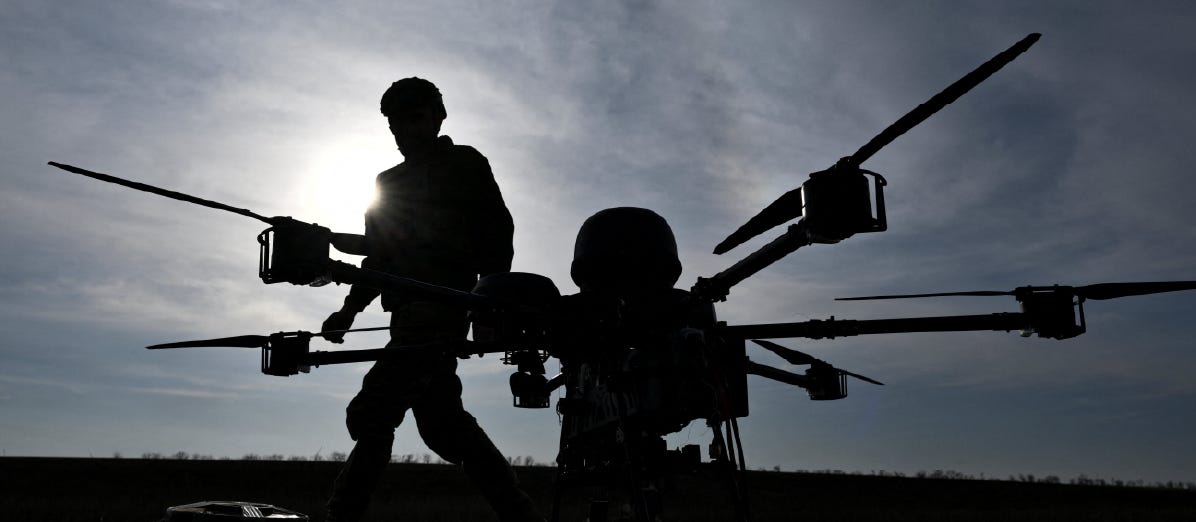
The Russian military has continued to experiment with improving its employment of uncrewed aerial systems (UAS) in support of its maneuver forces.
Both Russian and Ukrainian forces face coordination challenges and internal debates regarding the “ownership” of different depths of the battlespace and the command-and-control relationship between independent drone units and ground commanders.
While Ukraine typically leads in initial technological innovation, Russia has proven effective at copying these advancements and scaling them through systemic experiments across various military districts.
Despite narrowing the capability gap in 2025 through new employment concepts and elite units, Russian advancements have failed to produce a decisive military breakthrough.
For more from Rob and Dmytro, subscribe to Two Marines, a newsletter on Russia’s war in Ukraine, defense technology, and modern warfare.
By the numbers
39.1% - the proportion of their personal income that Russians are spending on food, according to the state statistical agency Rosstat. This is the highest indicator for the past 18 years, and it suggests that the growth in real incomes triggered by the wartime economic conjuncture has ended. In general, the lowest-income segments of the population spend the largest proportion of their income on food. High food spending is part of a wider social crisis, as households are also facing rising costs for utilities.
20% - the drop in military contract signings in Q1 2026 compared to the same period last year, according to Janis Kluge, a researcher at SWP Berlin specializing in budgetary issues. Kluge estimated, based on regional budget data, that recruitment was down to roughly 70,500 recruits for the quarter, despite signing bonuses reaching a record 1.5 million rubles per contract on average. This suggests that the pool of willing recruits is genuinely shrinking.
3.9 trillion rubles - Russian Railways’s (RZhD) debt as of the end of 2025, according to the company’s own financial records. Cargo volumes have declined since 2022, reflecting a broader crisis in the Russian economy, but also ineffective upkeep and management. Over the past months, RZhD has been engaged in debt restructuring negotiations, announced massive layoffs, and sold several of its real estate assets.
2% - Russia’s current unemployment rate, according to Central Bank Governor Elviria Nabiullina. Speaking at the Moscow Exchange Forum, Nabiullina warned that the country is facing a labor shortage for the first time in modern history. “This is a new reality for the government and for business alike,” she said, “We are facing a persistent downturn in external conditions affecting both exports and imports.” The Russian Central Bank cut its key rate by 50 bps to 15% at its last Board of Directors meeting, following a recent trend of rate cuts. The next rate decision meeting is scheduled for April 24.
175 for 175 - the number of Russian and Ukrainian POWs exchanged during an Easter prisoner swap mediated by the United Arab Emirates last weekend. According to Russian Human Rights Commissioner Tatiana Moskalkova, this included several civilians who were captured during Ukraine’s 2024 incursion into Kursk. Ukrainian President Volodymyr Zelenskyy also posted about the exchange on X. “Most have been in captivity since 2022. And finally—they are home,” he said.
— Andras Toth-Czifra & Sara Ashbaugh