

Operation Crab Trap
Russia unveiled the draft federal budget for 2024, which includes a steep increase in defense expenditures.
September 29, 2023
Hello from the Bear Market Brief!
This week in the news:
Ukraine launched a missile strike on the headquarters of the Russian Black Sea Fleet, claiming to kill the Black Sea Fleet commander, Admiral Viktor Sokolov.
Russia unveiled the draft federal budget for 2024, which includes a steep increase in defense expenditures.
Russian authorities are concerned with bringing inflation down ahead of the 2024 election year, since rising prices have sparked unrest in some regions.
Operation Crab Trap
On September 22, the Special Operations Forces of Ukraine launched a missile strike on the headquarters of the Russian Black Sea Fleet in temporarily occupied Sevastopol, Crimea. The headquarters were hit right as the Fleet’s leadership convened for a meeting.
On its Telegram channel, the Ukrainian Special Operations Forces referred to this missile strike as “Operation Crab Trap.” Following the attack, Ukraine’s Chief of Defence Intelligence, Kyrylo Budanov, commented that at least 9 people were killed and 16 wounded. On September 25, Special Operations Forces reported that 62 people were killed during the strike, including 34 officers, and over 100 Russians were wounded. Budanov added that among those wounded were Colonel General Alexander Romanchuk, the commander leading Russian forces in southern Ukraine, as well as Lieutenant General Oleg Tsekov, the commander of ground forces usually based in Arctic Russia. Both Russian commanders are believed to be seriously injured. The Russian media reported that one service member went missing following the attack, but neither the Kremlin nor Defense Ministry commented on Ukraine’s claims about the death toll.
Ukrainian sources also alleged that Russian Admiral Viktor Sokolov, commander of the Black Sea Fleet, was killed during the strike. Budanov initially did not confirm the information that Sokolov had been killed, but Ukrainian Special Operations Forces posted about Sokolov's death to Telegram on Monday. However, on Wednesday, the Russian Defense Ministry published a video that appeared to show the Admiral videoconferencing into a military meeting alongside other top officials. The Ministry said that this meeting took place on Tuesday, September 26, although the date of the video has not been independently verified. In response, Ukrainian Special Operations Forces said that it was “clarifying the information” about Sokolov’s death. “Many [deceased] still have not been identified due to the condition of the body parts,” it said in a statement.
Some international media outlets claimed that the attack on the Russian Black Sea Fleet was carried out using Storm Shadow cruise missiles. Budanov refused to provide any comments when he was asked about the role of Western-manufactured equipment during the operation. Whether or not Admiral Sokolov was killed in the attack, “Operation Crab Trap” represents a victory for Ukraine. The strike caused significant damage to the Black Sea Fleet’s headquarters, a major symbol of Russian presence in Crimea.
— Lisa Noskova & Sara Ashbaugh
Snapshot
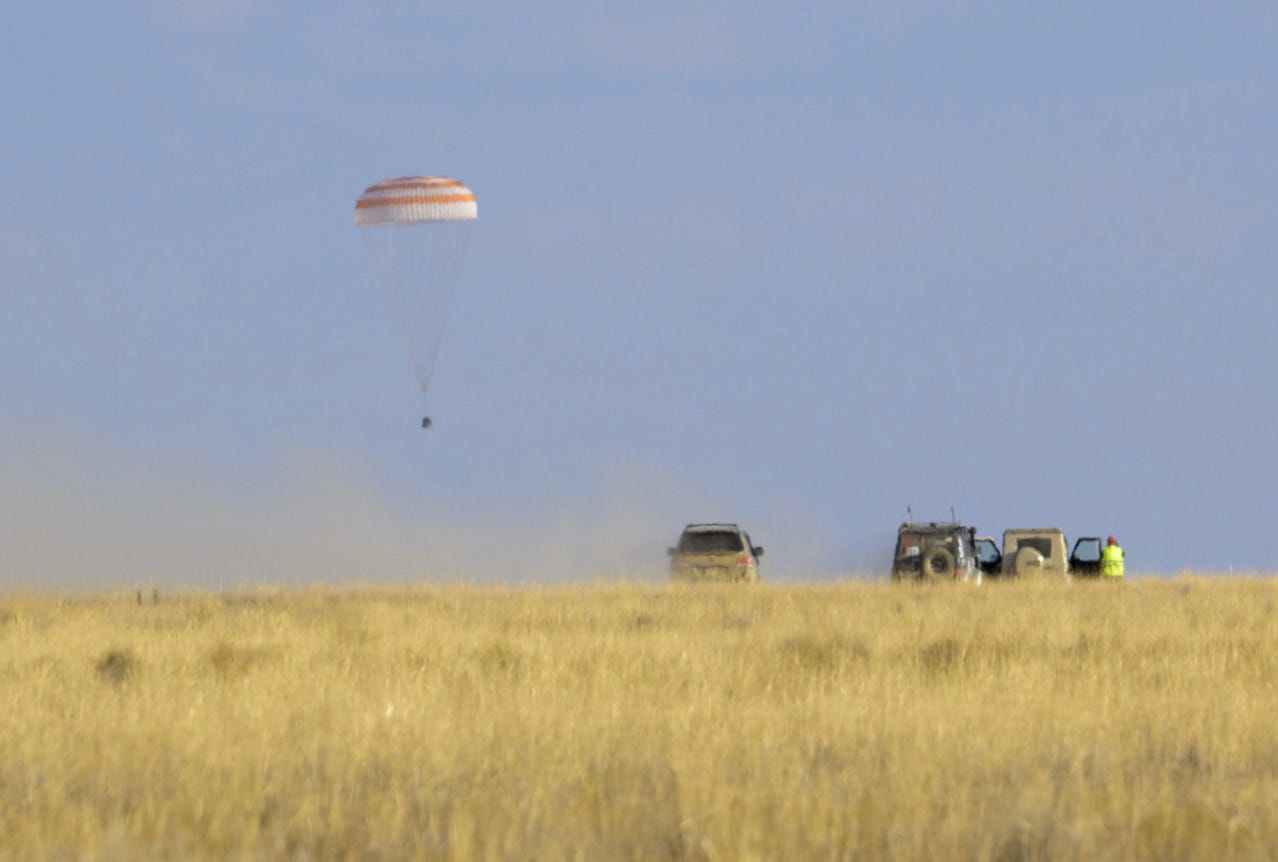
Two Russian cosmonauts and an American astronaut returned to Earth this week after more than a year in space. Cosmonauts Sergei Prokopyev and Dmitry Petelin and NASA astronaut Frank Rubio successfully landed near Zhezkazgan, Kazakhstan on Wednesday after a year aboard the International Space Station. The trio spent 371 days in space on a mission that was supposed to last only six months. Unexpected repairs necessitated their stay on the space station, making it the longest spaceflight ever under the ISS program. (photo: Bill Ingalls / NASA via AP)
A War Budget (if you've ever seen one)
Russia’s draft federal budget for 2024, which was unveiled this week, suggests that before the 2024 election, the Kremlin is going all-in on the war in Ukraine. Specifically, the Kremlin is attempting to rely more strongly on domestic war profiteers and the economic conjuncture generated by the defense industrial complex. According to the draft budget, in 2024, defense expenditures will grow from 6.4 trillion rubles ($66.3 billion) to 10.8 trillion rubles ($112 billion), roughly three times pre-war levels. Expenditures on national security—including domestic law enforcement and security services, which also experienced significant growth over the past years—will be kept roughly at level. Expenditures under the “social policy” heading, however, will increase to 7.5 trillion rubles ($77.7 billion) after 2023’s 6.5 trillion rubles ($67.3 billion). Regions (and large enterprises) will likely have to make up the numbers for both social security measures and expenditures under the “national economy” heading, which consists of state-funded investments. This will drop from 4.1 trillion ($42.4 billion) to 3.9 trillion rubles ($40.4 billion) in nominal terms, a more than 10% drop when inflation is factored in. State employees should not expect salary hikes in 2024.
In a further move to prop up the federal budget, last week, the government announced flexible export duties for most products (except for oil, oil products, gas, timber, grain, and certain types of machinery). The rate, moving between 4% and 7%, will depend on the ruble-US dollar exchange rate, with a 0% rate if the dollar is worth less than 80 rubles. The “temporary measure” will be in place from October 1 until the end of 2024. At the same time, the government proposed reestablishing the “budget rule” for oil and gas revenues in 2024 with a cut-off oil price of $60 per barrel, over which the surplus is added to reserves. This year, the government worked with a baseline revenue of 8 trillion rubles ($82.9 billion), thus the proposal reflects growing confidence about next year’s energy exports.
The flexible duty, once again, looks like a panicked reaction to a growing fiscal deficit with a short-term focus rather than a carefully designed fiscal policy. Exporters of several products—including metals and coal—are already suffering from discounts and higher transportation costs due to Russia’s forced pivot to Asia. This measure is likely to further reduce profit margins and discourage private investments. Food producers have also complained that the new duties will make their foreign sales unprofitable and may even lead to the production of certain items that are specifically grown for export.
— Andras Toth-Czifra
Snapshot
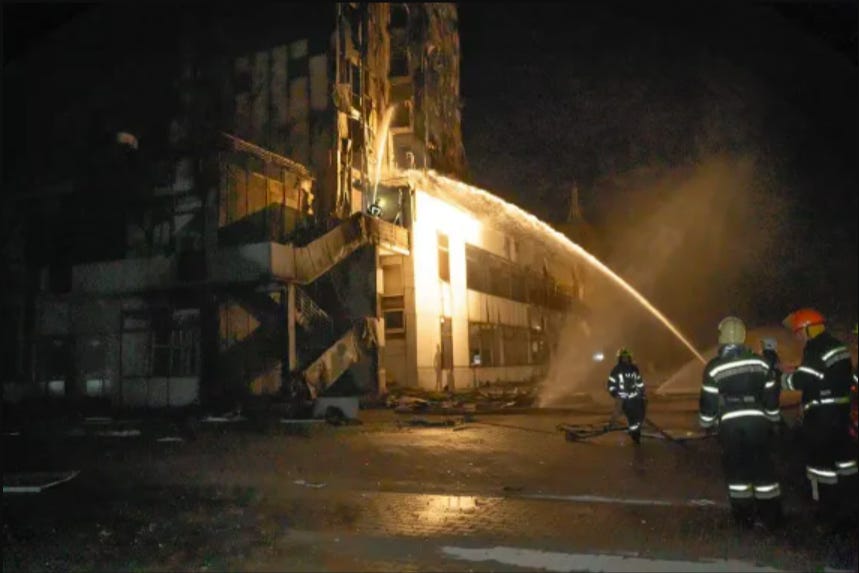
Firefighters work to extinguish a fire at Odesa’s seaport after a Russian attack. The September 25 attack resulted in at least two deaths and extensive damage to the port and nearby grain storage. Russia has been targeting Ukrainian agricultural facilities ever since it left the Black Sea Grain Initiative in July, leading some to accuse Russia of deliberately exacerbating global food insecurity.
(photo: Odesa Region Administration / AP)
The Specter of Inflation
Apart from the war, prices seem to be the authorities’ biggest concern ahead of the pivotal year of 2024. Domestic gas prices are scheduled to grow by a total of 20% in two steps over the next two years after Gazprom lost most of its export markets. Fuel prices kept rising even after the government temporarily suspended the export of commercial gasoline and diesel fuel on September 21. On September 27, Putin complained to the government that they had not done enough to temper domestic oil prices. Meanwhile, the export ban risks refineries scaling back their activities to avoid overstocking. In general, the government expects inflation to average 7.2% over 2024.
Higher prices have led to scattered protests in some regions, albeit the anger, at this point, typically seems to be directed at local authorities. This is exactly how Russia’s peculiar crisis management system is supposed to work, with Putin getting credit for bringing up the issue and regional officials—who were tasked last year to keep an eye on prices—receiving the blame. Rising housing utility tariffs are another explosive issue that has led to protests in several regions this year. These tariffs are also determined by regional governments, although the Economy Ministry establishes a ceiling (9.8% for 2024).
From the Kremlin’s point of view, the main task for the next six months is to avoid price hikes from becoming a unifying issue. This happened with the government’s pension reform in 2018, which created momentum for citizens to air their various grievances across the country. In the Altai Territory, one of the regions which saw such protests earlier this year, the Regional Parliament (with the votes of United Russia and the Liberal Democratic Party) curbed citizens’ right to assemble.
— Andras Toth-Czifra
On the Podcast
Have you heard calls for Ukraine and Russia to “just negotiate”? What does theory say about how (and why) wars come to an end? Christine Cheng joins to discuss.
Quickfire: Ukraine
Russia’s attack on Odesa on September 25 resulted in significant damages to the city’s Black Sea port and several historic buildings in Odesa downtown. Russia launched 12 Kalibr cruise missiles, 2 anti-ship Oniks missiles, and 19 Shahed drones in the attack, according to Ukraine’s Air Force. At least two people were killed as a result. Russia has been targeting Ukraine’s agricultural and port infrastructure ever since the Kremlin suspended the Black Sea Grain Initiative back in July.
The first batch of Abrams tanks that were promised to Ukraine by the U.S. arrived last weekend. Sources in the U.S. Defense Department told The New York Times that two platoons worth of tanks were delivered, likely 8-10 vehicles. This is only a fraction of the promised 31 tanks, the rest of which are expected to arrive in the coming months. President Zelenskyy wrote about the delivery on Telegram, calling it “good news.” Kremlin spokesman Dmitry Peskov commented that the Abrams tanks would not affect the outcome of the war. “They too will burn,” he said.
During President Zelenskyy’s visit to Canada last week, Canadian House of Commons Speaker Anthony Rota invited a Ukrainian WWII veteran to participate in the House of Commons meeting with the President. Since then, it was discovered that the veteran, 98-year-old Yaroslav Hunka, served in a Nazi unit. A Canadian Jewish organization, the Friends of the Simon Wiesenthal Center, announced that Hunka was a member of the Galicia Division, a Nazi military unit primarily made up of Ukrainian volunteers. Following the backlash from this announcement, Rota profusely apologized for inviting Hunka and resigned. Canadian Prime Minister Justin Trudeau also apologized, calling the incident “a mistake that deeply embarrassed Parliament and Canada.”
— Lisa Noskova & Sara Ashbaugh
Quickfire: Regions
On September 27, President Putin’s Office announced that Putin met Chechnya’s leader, Ramzan Kadyrov, in person, and published a video showing Putin and Kadyrov chatting in the President’s office. This is the strongest rebuttal yet from the Kremlin against recent rumors that the Chechen dictator’s health took a turn for the worse. Presidential spokesperson Dmitry Peskov had earlier refused to comment on the rumors, which gave rise to speculation that Kadyrov might indeed be gravely ill. The meeting also came just days after the publication of a video showing Kadyrov’s 15-year-old son, Adam, beating up a prisoner, which created backlash even in the Russian political elite. Kadyrov has created scandals in order to catch the President’s attention in the past. In the present situation, it is possible that Kadyrov—if the meeting indeed took place—felt like he needed to have an in-person audience to ensure that his and his family’s positions remain strong and that the federal money that props up Chechnya’s economy continues to flow.
Sergey Sokol, the Duma deputy and former war participant who ran for governor of the Khakassia Republic with the Kremlin’s support (but withdrew ostensibly due to his illness before the vote), was voted in as the Speaker of Khakassia’s newly-elected regional legislature. In his new position, heading a two-thirds United Russia majority in the chamber, Sokol will likely act as the Kremlin’s counterweight to the region’s Communist Governor, Valentin Konovalov. The Governor’s recent meetings with Anatoly Seryshev, the Kremlin’s Siberian plenipotentiary, and Andrey Turchak, the governing party’s Secretary General, suggest that, for now at least, the Kremlin is going to let Konovalov remain in office but keep him on a tight leash. The fact that several Communist deputies also voted for Sokol suggests that there is some kind of understanding between the Kremlin and the Governor. For the federal authorities, it is likely also important that Sokol won the position from long-standing Regional Speaker Vladimir Stygashev, who switched allegiances in the campaign and left United Russia to support Konovalov.
On September 28, reports appeared on Telegram about police searches at ZhIK Stroy due to fiscal debts. ZhIK Stroy is a company belonging to Emil Khusnutdinov, a deputy in the Parliament of Tatarstan. Khusnutdinov himself refuted the reports, but admitted that his company “faced problems.” A week earlier, another regional deputy, businessman, and the head of a charitable organization, Rustem Khasanov, was arrested for “illegal acquisition of narcotics.” That arrest appeared to have the full support of the Tatarstan government, whose head, Rustam Minnikhanov, condemned Khasanov. Both Khusnutdinov аnd, especially, Khasanov are seen as close to the Mayor of Kazan, Ilsur Metshin. The arrests (which are otherwise not entirely uncommon) have prompted speculations about a crackdown on local elite networks with the support of Minnikhanov.
— Andras Toth-Czifra