

Powerless to act
Power outages in the Murmansk region left thousands in the dark



Here’s what you might have missed this week:
Residents of Murmansk and Severomorsk were left without power for several days, leading to rolling blackouts and a state of emergency in the region.
Russia agreed to pause strikes on Kyiv at President Trump’s request ahead of this weekend’s peace talks in Abu Dhabi.
Novosibirsk’s legislative assembly voted to implement the federal government’s municipal reforms, eliminating more than 300 self-governing bodies.
— Sara Ashbaugh, Editor in Chief
Powerless to act
Over the past week, several thousand residents of Murmansk, Russia’s “Arctic capital,” and Severomorsk, the main base of Russia’s Northern Fleet, were left without power for four days due to an accident with aging infrastructure. The authorities initially promised to resolve the outages swiftly, but were unable to do so. They were then forced to introduce rolling blackouts and a state of emergency, which was raised on Wednesday after the network operator Rosseti installed temporary pylons. A couple of days prior, large snowdrifts paralyzed the Far Eastern region of Kamchatka, cutting off tens of thousands of residents and forcing many to leave their apartments through their windows as their entrances were completely blocked. Governor Vladimir Solodov admitted that the region lacked sufficient snow removal machinery and appealed to the federal government for help. In the middle of last week, Solodov claimed to President Putin that the situation was under control, even as local residents continued to complain about the authorities’ insufficient response. The situation in Kamchatka also drew attention to the authorities’ aggressive throttling of mobile internet, which impeded the normal operation of private and public services in Kamchatka enough for Solodov to request a suspension of the blocking. Even so, this week the State Duma adopted in the first reading a draft law that will allow the Federal Security Service to throttle even domestic internet services.
These incidents are only two of the largest involving public services and utilities that regional authorities have been unable to deal with. In the Altai Territory town of Rubtsovsk, more than 120,000 people had to be evacuated earlier this month due to a heating failure. Similar accidents happened over the past week in Ulan-Ude, Omsk, and a number of smaller cities. The list of accidents over the entire heating season is much longer, even without considering border regions such as Belgorod where Ukrainian drone strikes, responding to Russia’s relentless battering of Ukraine’s civilian infrastructure, have resulted in major utility outages.
In almost all of the regions with major outages, regional authorities have relied on local businesses and residents to provide essential aid to those affected. While Russians are usually ready to help in such cases, they have also voiced growing frustration over the worsening state of public utilities both online and in person. The vast majority of Russian utility and power networks are in need of repair, requiring an estimated 4.5 trillion rubles. Under the current war-focused fiscal circumstances, the Russian government has been reluctant to allocate these funds despite repeatedly promising to do so. The Kremlin is relying instead on regional governors and presidential plenipotentiaries to solve the problems where and when they arise and to assume political responsibility. The fact that at the same time utility tariffs have been growing across the country has led to localized protests in previous years in several regions. This year, likely due to the federal legislative election scheduled for September, the main tariff hike—which in some regions will be over 20% (significantly higher than inflation)—will take place on October 1.
— Andras Toth-Czifra
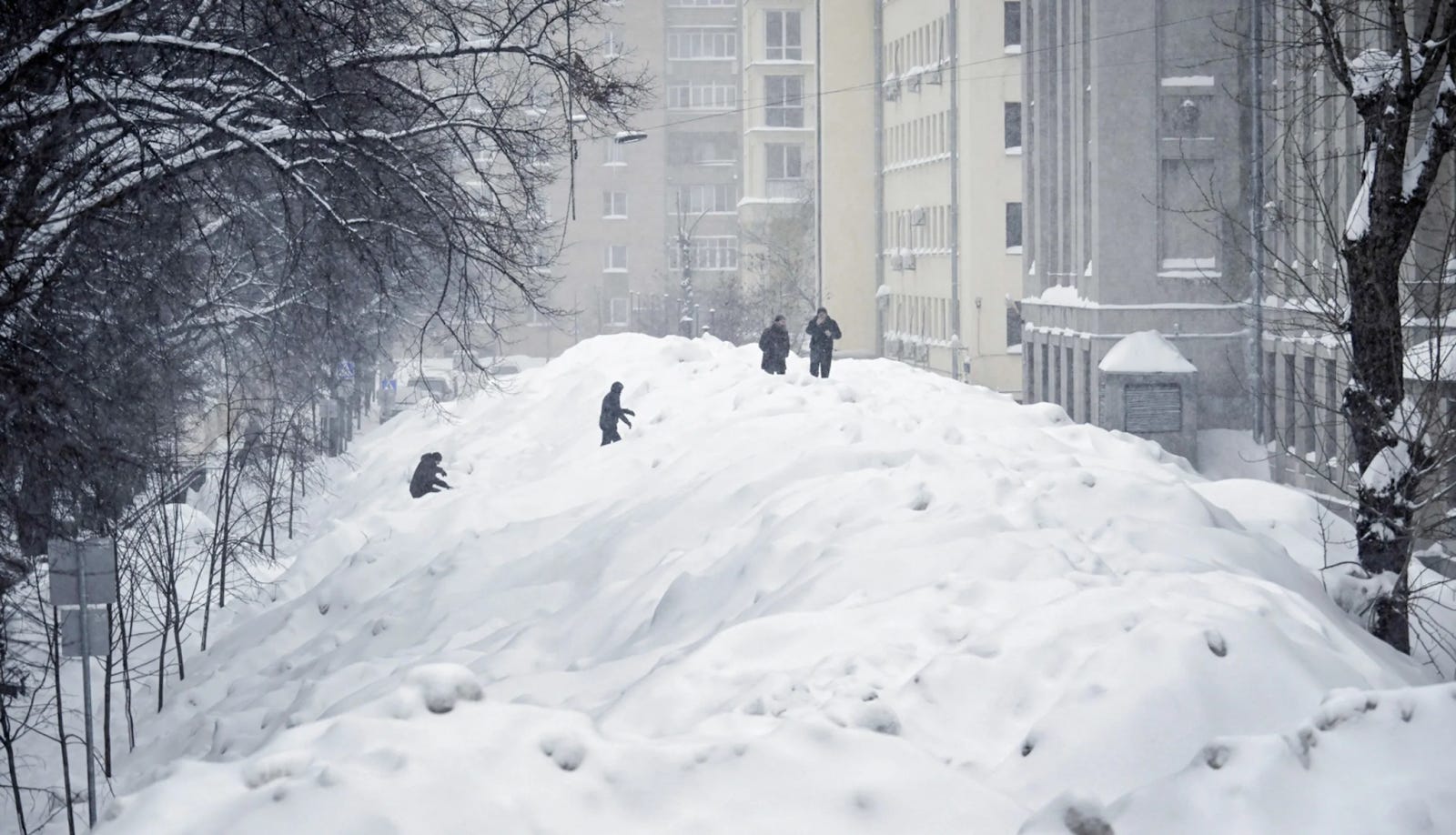
Moscow experienced heavy snowfall this week, with accumulation in the capital reaching up to two feet. Pictured here is the famous Miusskaya Snow Dune, a large snowdrift in Miusskaya Square where municipal workers pile snow from nearby streets. The massive dune, which first appeared during heavy snowfall in 2018, is so well-known by Muscovites as to have inspired its own merchandise and social media accounts. (photo: Alexander Nemenov / AFP / Scanpix / LETA)
Updates: War in Ukraine
On Thursday, U.S. President Trump announced that Russia agreed to pause strikes on Kyiv and other Ukrainian cities until February 1. According to Trump, he requested the temporary pause due to the extreme weather conditions in Ukraine. “They say they’ve never experienced such cold,” he said during a Cabinet meeting. Russia confirmed the pause in strikes but framed it as a gesture of goodwill for upcoming peace talks in Abu Dhabi, which are scheduled for this weekend. “I can say that President Trump did indeed make a personal request to President Putin to refrain from striking Kyiv for a week, until February 1, as a way to create more hospitable conditions for negotiations,” Kremlin spokesperson Dmitry Peskov said. On Friday, Ukrainian President Zelenskyy commented that there had been no direct agreement between Moscow and Kyiv, but that Ukraine would refrain from attacking Russian energy infrastructure if Russia did the same.
According to new estimates published by the Washington-based Center for Strategic and International Studies (CSIS) on Tuesday, Russian losses in the war in Ukraine have reached almost 1.2 million. “Russian forces have suffered approximately 1.2 million casualties (killed, wounded, and missing) and as many as 325,000 killed since February 2022,” the report states. Meanwhile, CSIS estimates that the Ukrainian Armed Forces have likely lost between 500,000 and 600,000 soldiers, including up to 140,000 killed. The Russian government disputed the CSIS’s findings, however, with Peskov claiming that only information provided by the Ministry of Defense can be trusted.
Russia and Ukraine completed an exchange of deceased soldiers on Thursday, the first such exchange of 2026. According to State Duma lawmaker Shamsail Saraliyev, Russia transferred the remains of 1,000 Ukrainian soldiers and received the bodies of 38 Russians in return. The exchange took place under the provisions of the Istanbul agreement, which saw the transfer of 14,871 total bodies in 2025. The Ukrainian headquarters for the treatment of prisoners of war confirmed the exchange, noting that Ukrainian institutions would now work to identify the repatriated deceased.
— Sara Ashbaugh
Quickfire: Regions
Ilya Seredyuk, the governor of the Kemerovo Region, had to publicly apologize after he put part of the blame on mothers for the deaths of nine newborn children in one of the region’s maternity clinics over the new year. The governor talked about the tragedy in his “Direct Line” television interview, a format that mimics Vladimir Putin’s carefully choreographed “interactive” television show, and said that pregnant women were unwilling to take necessary precautions and visit for consultations. Later, a Communist deputy in the State Duma called for the dismissal of the governor. The tragedy drew attention to staff shortages, the closure of midwife stations, and a lack of adequate health care funding in the region, which has been struggling with the crisis of its core industry, coal mining, for the second consecutive year. It also highlighted the general shortage of competent health care personnel in state-run clinics in the Russian countryside.
The Novosibirsk Region’s legislative assembly voted in two laws implementing the federal government’s municipal reform. The region, which had been one of the most politically pluralistic areas of the country over the past decade, will abolish the lower tier of municipalities and fold them into municipal districts, eliminating more than 300 self-governing bodies. The other regional law stipulates that, in the future, the mayor of the regional capital will be selected from candidates proposed by the regional governor—a Kremlin appointee. This eliminates even the theoretical possibility of an opposition or independent politician standing for this office and courting the support of local elites represented in the city council. Direct mayoral elections were already scrapped in 2023, amidst protest from opposition deputies, who have since been deprived of their mandates.
— Andras Toth-Czifra
Recent Report
From Front Line to Fault Line: Russia’s Challenge Managing Veteran Reintegration - András Tóth-Czifra
Russia’s policy execution structure decentralizes responsibility for the reintegration of war participants while centralizing credits for success stories. The execution of the policy is rife with political risks, but keeping the narrative of reintegration under tight control is a vital objective for the Kremlin. Read the report.
By the numbers
600 million rubles – the amount of wages that employers in the Kemerovo Region—most of them coal companies—owe their employees. To put this number into perspective, as of November 2025, the official amount of country-wide wage arrears was 1.77 billion rubles. Overall, this is still far from the amount of wage arrears that workers experienced in the 1990s, but as Kemerovo’s example shows, specific sectoral crises can lead to a significant concentration of arrears.
423 people – the bottom estimate for the number of people who have been killed in Russia by war participants returning from Ukraine, according to a research project by Novaya Gazeta. The violent behavior of traumatized veterans, many of whom are convicted felons, is one of the main concerns of the Russian authorities regarding their reintegration.
13.7% – Russian citizens’ inflation expectations, according to a survey ordered by the Central Bank. The rate has grown by more than one percentage point since October last year. Both the general population and businesses are expecting higher prices due to a VAT hike and other similar measures that came into force in January. This may slow down the bank’s rate cutting.
66 billion rubles – the amount for which Moscow’s Domodedovo Airport was sold to Perspektiva LLC, a subsidiary of Sheremetyevo International Airport. The final selling price at the Dutch-style auction on Thursday was down to half of the 132.2-billion-ruble starting price, according to RBC. Domodedovo was nationalized in June 2025 at the request of the Prosecutor General’s Office due to the foreign citizenship of its owners, Dmitry Kamenshchik and Valery Kogan. Sheremetyevo CEO Mikhail Vasilenko called Thursday’s acquisition “a business project aimed at rehabilitating an important part of the Moscow aviation hub.” Domodedovo’s new owners have also acquired the airport’s debt, which exceeds 70 billion rubles. Domodedovo is “an asset with significant debt, requiring significant financial investment,” the Transport Ministry noted.
— Andras Toth-Czifra & Sara Ashbaugh