

Purple rain
Smoke from damaged industrial facilities pollutes the air over Tuapse and Perm



Here’s what you might have missed this week:
Ukrainian drone strikes continue to target Russian oil infrastructure, hitting major oil facilities in Tuapse and Perm.
Last week, the EU approved its 20th sanctions package against Russia and a $106 billion loan for Ukraine.
President Putin announced the dismissal of Dagestan Governor Sergey Melikov, which may signal the beginning of a series of regional governor replacements.
— Sara Ashbaugh
Black rain in Tuapse
On Tuesday, Vladimir Putin denied that there was serious danger to residents and the environment in Tuapse, a city in the South Russian Krasnodar Territory where Ukrainian drone strikes hit a major oil refinery and adjacent oil product storage tanks four times over the past two weeks (the last hit occurring on April 30). Putin did, however, acknowledge that there was danger of an ecological disaster. Ukrainian military intelligence stated that the facility targeted by the drones was involved in supplying Russian troops operating in Ukraine.
Putin was not the only public figure who tried to minimize the impact of the strikes. Shortly after the second attack on the storage tanks, byproducts of oil combustion rained down on the city, covering the streets in toxic chemicals. According to official estimates, the concentration of toxic chemicals in the air was two or three times above safe levels as of last week. The actual numbers could be even higher. The smoke from the blaze has been reported visible from a distance of more than 100 kilometers, and oil products have spread more than 50 kilometers from the shore, with experts calling it the worst environmental disaster that the region has seen in several years. However, local officials did not issue advice on staying indoors and wearing masks until several days after the second strike, and Governor Veniamin Kondratyev only visited Tuapse after the third strike on the refinery. As of April 26, Alexander Kurenkov, the Minister for Emergency Situations, reported that the situation was “under control,” even though the authorities were reportedly still actively evacuating residents from the area several days later and the strikes disrupted gas and water provisions to many households. Krasnodar Emergency Services are operating with roughly 60% of the required equipment, suggesting that the authorities were unprepared for the strikes (despite Tuapse’s location and the earlier targeting of the refinery). At the same time, authorities detained a journalist who was preparing a report on the environmental damage caused by the strikes for Kedr, an independent news site. Local residents interviewed by Novaya Gazeta expressed bewilderment and anger at the regional and federal authorities for “abandoning” them.
The strikes on Tuapse were followed up by further successful Ukrainian drone strikes on Russia’s oil infrastructure. In the Perm Territory, drones hit oil pipeline infrastructure (although this was not confirmed by the authorities) and in the Orenburg Region city of Orsk, drones hit a refinery. Ukraine has expanded their range for drone attacks; a drone strike hit Yekaterinburg for the first time, damaging a residential building (the actual target seemed to be the Vektor defense plant). In these cases, apart from damaging Russia’s oil and oil product export capacity in order to limit Russian gains from the continuing closure of the Strait of Hormuz, the strikes also seem to further fuel Russian citizens’ distrust in the capacity of local and federal authorities to protect them from the direct effects of the war. This may even contribute to the shifting of public opinion in favor of pausing or ending the war.
— Andras Toth-Czifra
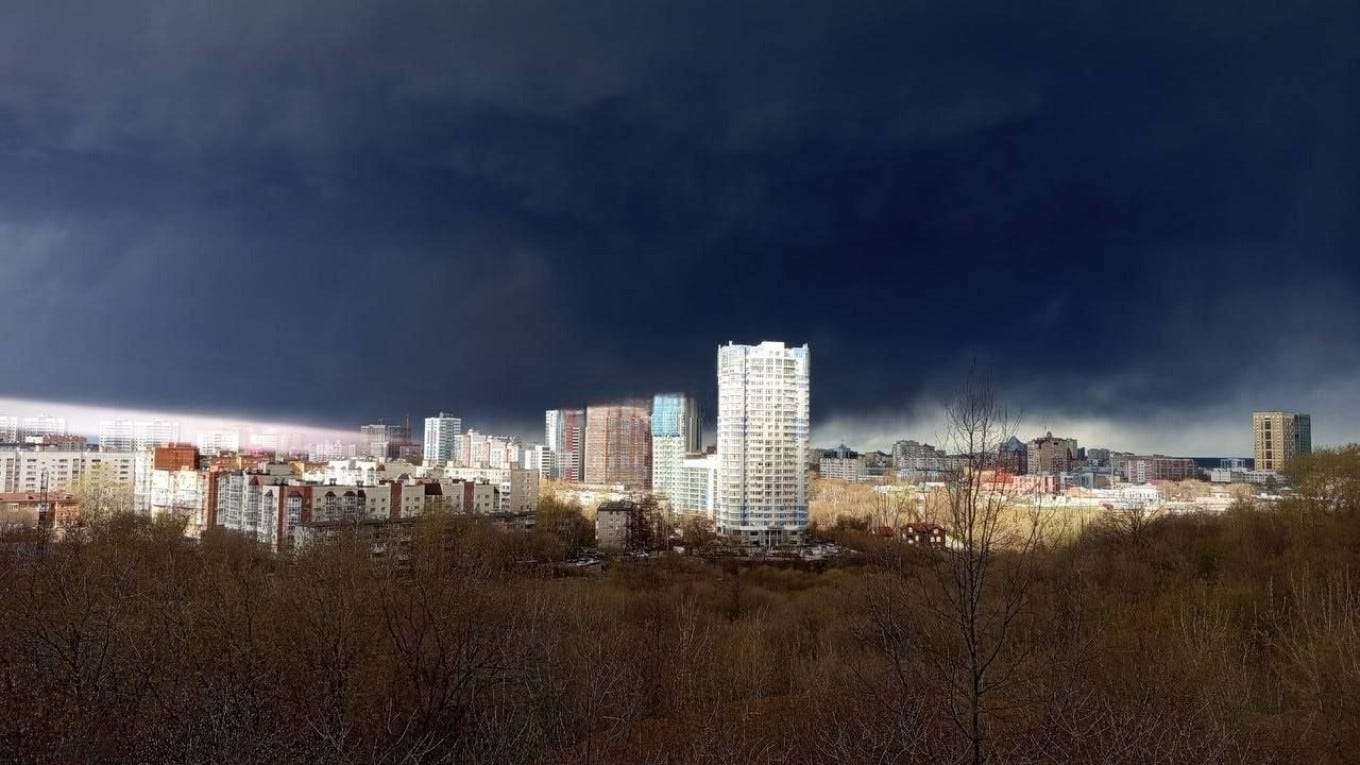
The sky over Russia’s Perm Territory was black with smoke after a Ukrainian drone strike on Wednesday morning. Perm Governor Dmitry Makhonin confirmed the strike in a Telegram post, announcing that a fire had broken out at an “industrial site” in the region. According to Ukrainian media, the drones struck an oil pumping station known as the Perm Linear Production Dispatch Station and, the next day, the Lukoil-Permnefteorgsintez oil refinery. Russia’s Rospotrebnadzor (the Federal Service for the Oversight of Consumer Protection and Welfare) said that the situation is “under control” and advised Perm residents to stay indoors if they begin to feel unwell. (photo: @exilenova_plus / Telegram)
New EU sanctions
The EU adopted its 20th sanctions package against Russia last Thursday, targeting Russian oil revenue and shadow fleet tankers. The package was originally intended for February to mark the anniversary of Russia’s invasion of Ukraine, but it was blocked by vetoes from member states Hungary and Slovakia. The two countries accused Ukraine of intentionally delaying repairs to the Druzhba pipeline—a major Russian oil pipeline running through Ukraine—and refused to approve the new sanctions package until the flow of oil was resumed. The pipeline, which Ukrainian officials claim was damaged during a Russian attack (halting its flow of roughly 1.4 million barrels of oil per day), is an important source of fuel for Hungary and Slovakia. On April 21, Ukrainian President Zelenskyy announced that repairs to the pipeline were officially complete. “The pipeline can resume operation,” he posted on X, restoring its supply to Hungary and Slovakia for the first time in three months.
The new sanctions package builds on the EU’s ongoing efforts to restrict Russian oil revenue, which helps to fund its war in Ukraine. The package adds another 46 ships to the list of blacklisted shadow fleet tankers, bringing the total number of ships to 632. It also sanctions a further 36 companies across the oil supply chain and dozens of foreign companies accused of supplying Russia with “dual-use” goods. Transactions have been prohibited with an additional 20 Russian banks, and the new sanctions package also bans the import of certain Russian metals and industrial materials. Additionally, the EU also approved a 90 billion euro ($106 billion) loan for Ukraine. The loan is expected to cover two-thirds of Ukraine’s funding needs for 2026-2027, with the money going toward budgetary support, weapons procurement, and domestic arms manufacturing. Zelenskyy thanked the bloc for their support, saying, “This will strengthen, of course first of all our army, Ukrainian forces, and allow us to boost production.” Ukraine is not expected to repay the loan until Russia pays reparations for the war.
The Russian diplomatic mission to the EU protested the new sanctions, calling them “economic coercion” and a “complete disregard for international law.” Only sanctions approved by the UN Security Council are legitimate, the diplomatic mission said, and “all unlawful actions by the European Union against our country will undoubtedly receive an appropriate and timely response.”
— Sara Ashbaugh
Quickfire: Regions
In a move that may signal the beginning of a series of dismissals of regional governors, President Putin announced on April 30 that Dagestan Governor Sergey Melikov will be leaving office in September and the regional legislature will vote on a successor. Melikov will reportedly be succeeded by Fyodor Shchukin, the head of the republic’s Supreme Court. Shchukin has no prior experience in politics or public administration, and Magomed Ramazanov, so far a deputy presidential plenipotentiary in the Far Eastern Federal District, is expected to be his Prime Minister. Earlier in April, Ramazanov was tasked by Putin to take charge of the disaster response in Dagestan after the region was hit by a “once-in-a-century” flood. Melikov was dismissed rather unceremoniously, with the president announcing it at a meeting with Dagestani representatives where the governor was not present. His position has been shaky for a while due to a series of governance failures in the region, of which the flood response was only the latest. However, due to his security background, Melikov was also trusted with keeping the often-restive region stable. If the president is going to dismiss any further regional governors this spring, he will likely do so in the coming couple of weeks. Another official who faced rumors of dismissal is Belgorod Governor Vyacheslav Gladkov. The Vedomosti weekly speculated that Gladkov could be demoted to an envoy to Abkhazia, with Alexander Shuvaev, a former soldier and current deputy governor in the Irkutsk Region, replacing him. This has not been confirmed as of this writing.
Denis Butsaev, a recently-resigned Deputy Environment Minister and former head of the Russian Ecological Operator (the federal organization tasked to carry out the Kremlin’s largely failed waste management reform), has fled the country. He is likely trying to avoid corruption charges linked to several former directors of the Russian Ecological Operator, according to the Vedomosti weekly. Journalist Farida Rustamova confirmed that, according to her sources, Butsaev fled via Minsk and Tbilisi to the United States, helped by the fact that he had not been sanctioned by the U.S. or the EU. If Vedomosti’s information is correct, Butsaev is the first high official who has been able and willing to flee the country to the West as a result of the current domestic crackdown on federal and regional public officials accused of corruption. Notably, just a few days ago, he was rumored to be a potential successor to Belgorod Governor Vyacheslav Gladkov (see above) given his prior work in the region.
In a rare public clash, Federation Council Speaker Valentina Matvienko called on Alexei Mordashov, the majority owner of the Severstal company, to return part of his offshore assets to Russia, framing it as assistance to the struggling Vologda Region where Severstal is based. Severstal’s press service denied the existence of offshore assets, pointing to Western sanctions and the construction sector crisis as the cause of the company’s declining tax payments to the regional budget. Matvienko’s suggestion marks an escalation of the existing conflict over Severstal; Vologda Governor Georgy Filimonov has been engaged in a dispute with the company and its officials for several years. The regional budget did experience a sharp drop in corporate income tax receipts in 2025-2026, leading to a deficit worth 35% of its own revenues in 2025. However, the metallurgy sector as a whole is experiencing a worsening crisis; collapsing domestic demand and difficulties with exports are significantly reducing profitability.
— Andras Toth-Czifra
Russia’s Drone Line Experiment
By Rob Lee and Dmytro Putiata
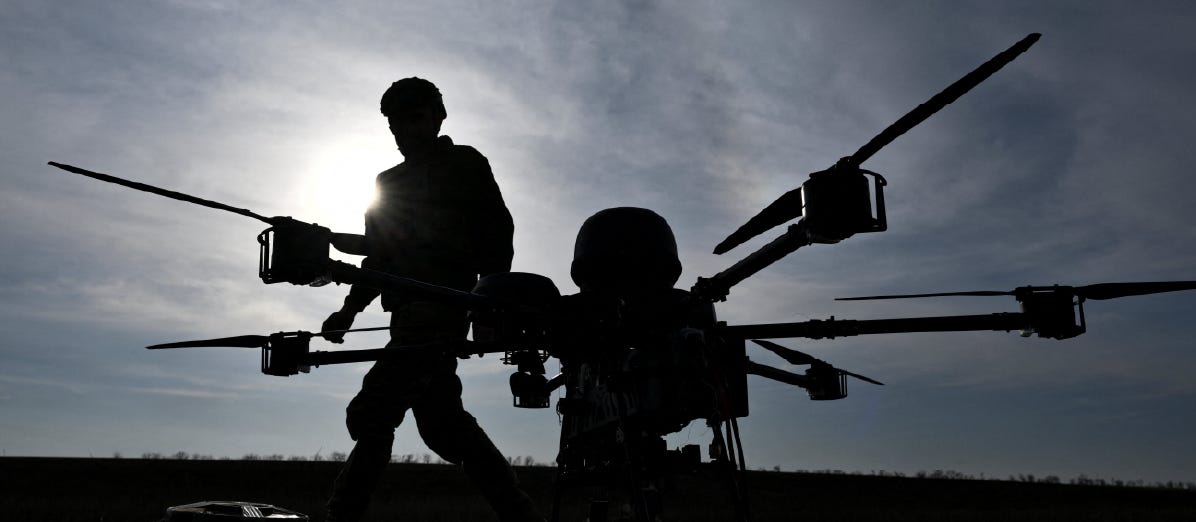
The Russian military has continued to experiment with improving its employment of uncrewed aerial systems (UAS) in support of its maneuver forces.
Both Russian and Ukrainian forces face coordination challenges and internal debates regarding the “ownership” of different depths of the battlespace and the command-and-control relationship between independent drone units and ground commanders.
While Ukraine typically leads in initial technological innovation, Russia has proven effective at copying these advancements and scaling them through systemic experiments across various military districts.
Despite narrowing the capability gap in 2025 through new employment concepts and elite units, Russian advancements have failed to produce a decisive military breakthrough.
For more from Rob and Dmytro, subscribe to Two Marines, a newsletter on Russia’s war in Ukraine, defense technology, and modern warfare.
By the numbers
-2.2% - the fall of business turnover in nominal terms in the first three months of 2026, according to a Sberbank analysis. This is the first such drop since 2022. The bank attributed this deterioration to the Central Bank’s tight monetary policy. Even though the Central Bank cut the key rate to 14.5% last week, it widened its 2027 rate corridor to 8-10%, suggesting that the inflation risks stemming from the current oil crisis warrant a more cautious rate cutting policy. The Central Bank’s GDP growth forecast for 2026 is now 0.5-1.5%.
1% - the veteran employment quota that Tatarstan is introducing starting in September for companies with more than 200 employees in order to help with the reintegration of returning soldiers. Tatarstan’s quota is less intrusive than what has been introduced in other regions (roughly half of Russian regions now have quotas like this), many of which require companies with more than 100 employees to employ a certain number of war participants. This signals that the authorities are keen to pass on at least part of the reintegration costs to the private sector.
76,000 people - the number of people left without power after unusually severe weather this week. Extreme winds downed trees and power lines across Russia on Monday, and at least 32 people were injured and several were killed according to the Emergency Situations Ministry. Moscow and the surrounding regions experienced unprecedented snowfall for this time of year. Roughly 21 centimeters (8.3 inches) accumulated during the rare spring snowstorm in the capital city on Monday morning.
90 minutes - the length of the telephone call between President Putin and his U.S. counterpart Donald Trump this week. The tone of the call was “frank and businesslike” Kremlin aide Yuri Ushakov told reporters on Wednesday. According to Ushakov, the pair discussed the war in Iran and the conflict in Ukraine, with President Trump supporting Putin’s initiative to declare a temporary ceasefire for the Victory Day holiday next week. Trump called the phone call a “very good conversation” and added that Putin had offered Russia’s diplomatic “help” end the war in Iran.
— Andras Toth-Czifra & Sara Ashbaugh