

Ripple effects
The ongoing fuel crisis begins to affect other industries



Here’s what you might have missed this week:
The ongoing fuel crisis in Russia has begun to affect other industries, including retail, agriculture, and tourism.
Russia is reportedly restricting shipping through the Sea of Azov in response to a Ukrainian drone campaign against Russian commercial vessels.
Yakutsk Mayor Yevgeny Grigoriev resigned so that the region can comply with the federal municipal reform eliminating direct mayoral elections.
— Sara Ashbaugh
Fuel crisis in the real economy
Russia’s ongoing fuel crisis, exacerbated by a campaign of Ukrainian drone strikes, is increasingly affecting the real economy and public services. While the situation is not critical yet, the cumulative effects of the crisis over time risk reinforcing each other.
Fuel shortages and price hikes have fed into transportation costs, which will have secondary effects on inflation in the coming weeks. The FTL (full truckload) freight index published by the ATI.su freight exchange website rose 17.5% over six weeks, hitting a record 2,086 points in July. Specific routes between major cities saw an even steeper rise and due to a shortage of available wagons—switching to rail transit is not always an option. An increasing number of regions are seeing public transit disruptions due to fare hikes or reduced schedules because of higher fuel costs.
Apart from driving up prices indirectly, higher fuel costs also directly impact retail. The Union of Shopping Centers estimated that large shopping malls could lose an additional 3-7% of spontaneous traffic over several months due to shoppers opting to skip trips. A similar squeeze is affecting driving-dependent tourism. Deliveries that depend on fuel-powered vehicles will also be affected; some food service companies are reportedly already raising delivery thresholds to offset rising delivery costs. According to Avtostat, new car sales fell 16% week-on-week from July 6-12, bringing further stress to an already depressed sector. Levada’s Consumer Sentiment Index fell below the 100-point optimism/pessimism threshold for the first time since October 2022.
Agricultural enterprises that depend on fuel for the harvest are also suffering, albeit not equally everywhere. The Altai Territory formally requested a state of emergency, citing a real risk that farms halt operations mid-harvest. Similar distress signals came from the Irkutsk Region and from Southern Russia.
The crisis is also affecting public services. The pro-Kremlin Izvestia daily found that the number of failed or re-announced government tenders for fuel serving hospitals, fire services, and utilities tripled in the past two months year-on-year. Suppliers find fixed-price government contracts unprofitable under the current circumstances. Several regions reported waste collection disruptions due to fuel shortages. This will put further strain on regional budgets, which will likely show up in the coming months. Peripheral regions are especially vulnerable, as Deputy Prime Minister Alexander Novak also warned. Meanwhile, the Verstka media outlet reported that the federal government banned governors from looking for available fuel on the open market.
If the Central Bank finds that the fuel crisis represents significant inflationary pressure, it will likely further slow down or even reverse its rate-cutting process. This would, in turn, further squeeze employers in the real economy that are expecting lower rates to start investing and lessen their debt burden.
— Andras Toth-Czifra

Heavy rainfall led to severe flooding in Sverdlovsk, causing local authorities to declare a state of emergency in parts of the region. Rainstorms over the Ural Mountains have caused widespread power outages, blocked roads, and flooded more than 400 homes across the region. A storm last Friday left 25 settlements without power, affecting more than 10,000 people in total. The village of Kilachevskoye in the Irbitsky District, pictured here, was particularly hard hit by the flooding. (photo: Donat Sorokin / TASS / ZUMA Press / Scanpix / LETA)
Shipping restrictions in the Sea of Azov
Russia is reportedly considering rerouting its grain and oil shipments from the Sea of Azov due to Ukrainian drone attacks. Around a quarter of Russia’s grain exports pass through the Sea of Azov, and Russia’s largest grain-producing regions, Rostov and Krasnodar, lie along the coast. The occupied Ukrainian regions of Kherson, Donetsk, Zaporizhzhia, and Crimea are also adjacent to the Sea of Azov.
For the past two weeks, Ukraine has been conducting a significant drone operation focused on Russian commercial vessels. According to the Ukrainian Unmanned Systems Forces Commander, Robert “Madyar” Brovdi, Ukrainian drones targeted 117 Russian vessels in the Sea of Azov and 30 in the Black Sea between July 6 and 16. The operation, nicknamed “MoLoChKa,” aims to disrupt Russia’s maritime transport and logistics networks without damaging the ships’ hulls and causing oil spills, Brovdi said. Targets include Russian cargo ships, ferries, tugboats, and so-called “feeder” ships, which ferry oil from shallow ports to large oceangoing tankers. “The paralysis of Russia’s feeder fleet essentially makes it impossible to export ‘black gold’ from Russia’s oil terminals through the Volga-Don Canal and the Sea of Azov,” Brovdi said. Experts interviewed by the Financial Times called it the largest instance of naval warfare in the last 50 years. “I cannot stress enough how unprecedented this is,” Thomas Alexa, a senior analyst at maritime security firm Ambrey, said.
According to industry sources cited by Reuters, the Russian government has been restricting shipping through the Sea of Azov since last Friday. One source told Reuters that ships are allowed to move freely in the Sea but are prohibited from entering or leaving the Kerch Strait or the Don-Azov channel, which eventually connects to the Caspian Sea. Neither the Russian agriculture nor transport ministries have officially confirmed the restrictions, although the Ministry of Agriculture did state that grain shipments may be diverted if needed. “Given Russia’s significant capacity for handling agricultural cargo in various regions, supply logistics will be rerouted if necessary,” the Ministry said.
— Sara Ashbaugh
In The Latest Russia-Belarus Non-Strategic Nuclear Exercise, Putin and Lukashenka Show Teeth
By Gabriela I. Rosa-Hernandez & Decker Eveleth

In mid-May, Belarus and Russia announced that they would conduct military exercises involving the delivery of nuclear weapons to units in the field. Over the next three days, imagery emerged of Russian and Belarusian forces practicing for the employment of nuclear weapons, including mock deliveries of nuclear warheads to Belarusian missile units. The exercises were trumpeted by both Russian and Belarusian political leadership as an important step in achieving both Russian and Belarusian security against foreign threats. President Vladimir Putin said this exercise was the first joint training of the Russian and Belarusian armies on the management of strategic and tactical nuclear forces since Russia and Belarus announced their nuclear-sharing arrangement—perhaps the most significant change in Russia’s nuclear posture since its full-scale invasion of Ukraine.
Quickfire: Regions
Two stories from last week show Russia’s cost-shifting mechanism in practice, which increasingly pushes the costs of war on to lower-level budgets and the private sector. The mayor of Bodaibo, a major gold-mining city in the Irkutsk Region that made national news several times this year due to the breakdown of its utility infrastructure, publicly blamed the regional government for neglecting the city. Bodaibo is set to lose over 500 million rubles in tax revenue to the regional budget under a reallocation law originally planned for 2029, which was pushed forward to 2027 due to the worsening problems of the regional budget. Meanwhile, Dozhd, an independent television network, obtained a district recruitment plan from Buryatia showing that enterprises were assigned quotas of men to send to recruitment offices. Businesses unable or unwilling to comply were reportedly charged 100,000-450,000 rubles per missing soldier. There is reason to believe, according to the outlet, that this scheme operates throughout Russia. It would not be surprising given the slowdown of military recruitment this year. The centralization of revenues and decentralization of costs has long been a main feature of Russia’s crisis management system. However, the rapidly increasing cost of the war is putting growing strain on the power structures underpinning it.
Yakutsk’s mayor, Yevgeny Grigoriev, resigned so that the city council—now required by the region’s municipal reform, tied to the 2025 federal reform—can appoint a governor-nominated successor. For a while, Yakutsk was one of the last holdouts among Russia’s regional capitals that resisted federal plans to cancel direct mayoral elections, with city assembly deputies even challenging Yakutsk’s version of the federal reform before it was adopted in 2025. Grigoriev’s election itself was a step down the road of cancelling direct elections; he was elected mayor in 2021 as a “government-friendly” candidate after his predecessor, Sardana Avksentieva, resigned. Avksentieva was elected in 2018 in a wave of protest votes across Siberia and the Far East. She did not openly oppose the Kremlin or the governor of the Sakha Republic, but she represented a more independent style of municipal governance and was seen as a potentially dangerous challenger to established elites. She later became a Duma deputy of the New People Party. The Kremlin-backed municipal reform has led to localized protests over the past two years, but ultimately the replacement of direct mayoral elections with fully controlled votes where governors appoint the candidates has been reluctantly accepted almost everywhere.
— Andras Toth-Czifra
Upcoming Virtual Event: July 21, 12-1 PM EDT
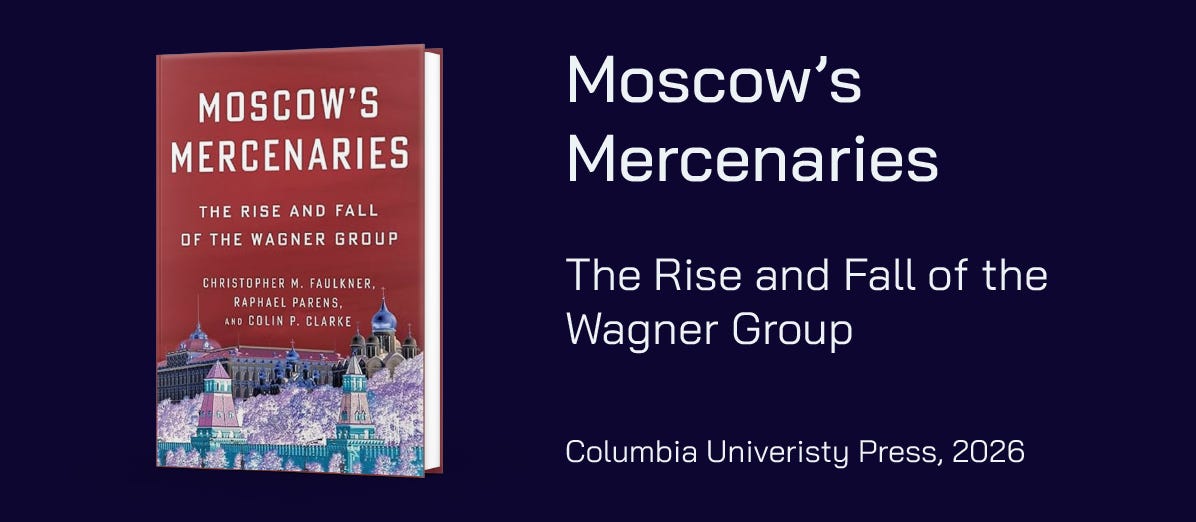
Join FPRI’s Eurasia Program for a book talk hosted by Program Director Dr. Emily Holland marking the release of Moscow’s Mercenaries: The Rise and Fall of the Wagner Group with authors Christopher M. Faulkner, Raphael Parens, and Colin P. Clarke. The discussion will examine Wagner’s emergence into one of the world’s most notorious private military companies, its role in Ukraine, Syria, Libya, the Central African Republic, Mali, and beyond, and its deep connections to the Kremlin. The conversation will also explore what Wagner’s rise and collapse reveal about the Russian regime, power projection, authoritarian outsourcing of violence, irregular warfare, and the future of mercenary activity in global security.
By the numbers
Roughly $50 per 1,000 cubic meters - the domestic gas price that China wants Gazprom to charge if it is to sign a final agreement on the Power of Siberia 2 pipeline, according to reporting in the Wall Street Journal. China currently pays $258 per 1,000 cubic meters of gas purchased through the Power of Siberia 1 pipeline, which itself is a heavily discounted price. However, sealing the deal on the second pipeline has been a politically significant and elusive goal of the Russian government for years.
25.6% - the amount by which trade between Russia and China rose year-over-year in the first half of 2026, according to Russian official data. Trade between the two countries reached $134.2 billion by July—a reversal from 2025, when bilateral trade fell for the first time since 2020. President Putin and Chinese President Xi Jinping have boasted a “no limits” partnership between Russia and China, and the two countries have been increasing their economic cooperation since the Russian invasion of Ukraine in 2022.
1000 rubles - the fine for anti-war politician and former presidential candidate Boris Nadezhdin. Nadezhdin was briefly detained this week and banned from leaving the country after he was charged with displaying “extremist symbols.” The charge was related to a photo of Alexei Navalny that appeared in a video linked on Nadezhdin’s Telegram channel. The purpose of the arrest is likely to discourage Nadezhdin from trying to run in the September State Duma election as an independent candidate. He was also labeled a “foreign agent” this week. His charge carried a maximum sentence of 15 days in prison. “I’m glad I’m alive and free,” Nadezhdin said following the verdict. His attorney says he plans to appeal.
4.83 trillion rubles - the Finance Ministry’s new forecast for the federal deficit in 2026—more than one trillion rubles higher than the originally budgeted deficit. The higher deficit is a result of higher planned spending. However, the forecast presupposes that the government will be able to restrict spending or increase revenues in the second half of the year, as the deficit in the first six months was 5.73 trillion rubles (or 2.5% of GDP). It is likely worth assuming that this is a conservative estimate.
— Andras Toth-Czifra & Sara Ashbaugh