

Whither, Piter?
The St. Petersburg International Economic Forum began on Wednesday


Here’s what you might have missed this week:
The St. Petersburg International Economic Forum kicked off on June 3, but Russian business leaders are increasingly concerned about the state of the wartime economy.
Altai Republic activist Aruna Arna was sentenced to five years in a penal colony for reposting covers of revolutionary songs on her Telegram channel.
The First Deputy Governor of Novosibirsk, Yury Petukhov, was detained in Moscow during the latest wave of corruption crackdowns on regional administrative elites.
— Sara Ashbaugh
Whither, Piter?
The St. Petersburg International Economic Forum, Russia’s flagship gathering of economics professionals, business leaders, and public officials, started on June 3. Vladimir Putin himself addressed the event on Friday, June 5, albeit he also spoke about the war in Ukraine in St. Petersburg a day prior without mentioning anything new. The event takes place against the backdrop of increasingly gloomy prospects for Russia’s economy and growing elite tension over the distribution of the cost of the war in Ukraine, with no clear way out for Russia.
In recent years, the Kremlin has tried to use the forum to signal that Russia’s international isolation is not absolute despite U.S. and European sanctions. Regional leaders also often time the announcement of major investment deals to coincide with the forum. This year, the federal government announced the privatization of stakes in the Novorossiysk Port and the state-owned airline Aeroflot. However, the list of attendees has shrunk noticeably over the last few years, especially after the full-scale invasion of Ukraine. This time, a small U.S. delegation took part in the event. This is important for the Kremlin, since it has tried to woo the Trump administration with the promise of lucrative investment deals. The delegation is rather symbolic, however, and includes people such as the Chairman of the U.S. Commission of Fine Arts, Rodney Mims Cook Jr., who is overseeing the construction of Donald Trump’s White House ballroom (and thus could be expected to have the president’s ear). It also includes conspiracy theorist Candace Owens and possibly the Tate brothers, who are under investigation for human trafficking and were spotted in Moscow. Chinese and Saudi delegations include higher-ranking officials.
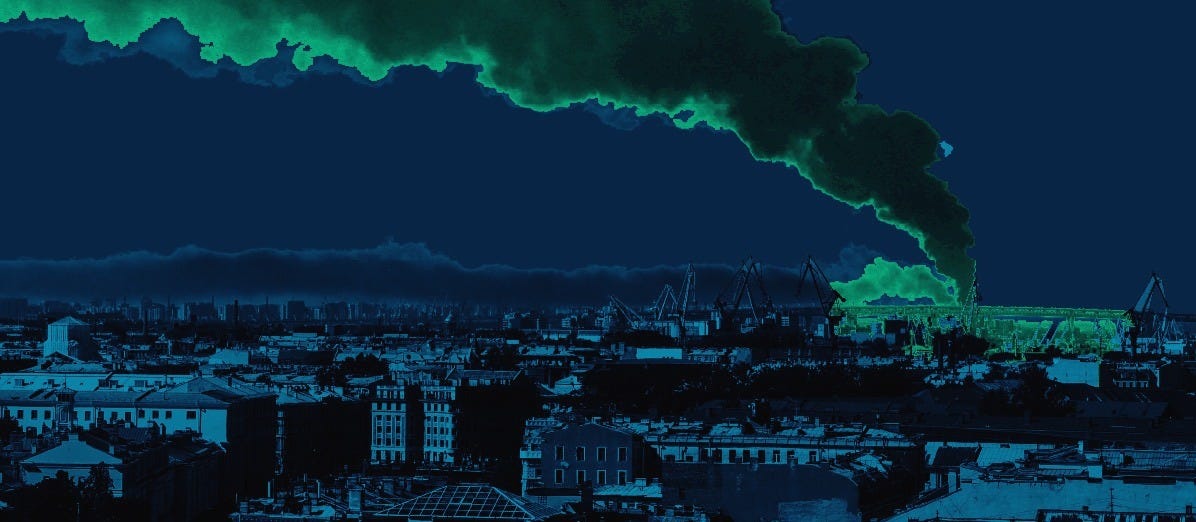
A couple of hours prior to the opening of the forum, a Ukrainian drone carried out a successful attack on an oil facility in Kronshtadt, near St. Petersburg. This is the second attack in or near the city over the past few days, underlining Ukraine’s recent successful drone campaign against Russia’s oil refining, storage, and export infrastructure, and against land supply lines to the occupied Crimea. Russian refinery throughput in May had fallen to 4.58 million barrels per day, according to estimates from analytics firm OilX. While analysts have warned that production is difficult to track, this would be a capacity drop not experienced since 2009. Fuel rationing has now been reported in a growing number of regions, including St. Petersburg itself, and the government recently banned the export of jet fuel. Deputy Prime Minister Alexander Novak, however, called the situation “stable” at the forum, while also underlining that Russia’s oil export was at maximum capacity due to dropping domestic refining.
The wider economic picture is not looking good either. Shortly before the opening of the forum, the government-linked Center for Macroeconomic Analysis and Short-term Forecasting (TsMAKP) announced that Russia has entered a period of stagflation. The Ministry of Economic Development cut its 2026 growth forecast to 0.4%. Investments fell sharply in the first quarter of the year, and the strengthening ruble—a product of higher oil exports—is discouraging other exporters: AvtoVAZ announced this week that it is cutting production targets because the strong ruble makes exports unviable, with major metallurgical companies also announcing that they would not pay dividends. 93% of small business owners think that the situation is worsening for them after the tax reform launched earlier this year, which Putin proposed slowing down or halting in his speech.
Economy Minister Maxim Oreshkin compared Russia’s 10% economic growth over the past three years to lower growth rates in Europe; this has become almost a tradition for Russian officials. Putin himself, while allowing that the federal budget’s deficit would be higher than planned, said that it would still be “lower than in other developed countries.” He made a comparison between the collective West and BRICS economies, which somewhat generously loops Chinese technological advances together with Russia’s economy. However, Russian growth is now entirely driven by the defense industrial complex and continued war spending, which, according to Bloomberg, Finance Ministry officials have recently privately told Putin was unsustainable. A Moscow Times survey of business leaders before the forum also found that most agree: the only thing that will lead to sustainable growth is ending the war. On this note, Oreshkin did tell attendees of the forum that they should not expect a return to the pre-war growth model, a thought also voiced in a slightly different tone by Rosneft advisor and ex-spy Andrey Bezrukov, who said that Russia will be at war for the next few decades.
The absence of Central Bank head Elvira Nabiullina at the forum was widely noted. Nabiullina is considered one of the key technocrats trusted with ensuring wartime economic stability. She officially took a sick leave, but she has reportedly been asking to be allowed to retire from the Central Bank when her mandate runs out in 2027. This underlines a shift within Russia’s administrative elite and a growing feeling that the only alternative to ending the war, the best window for which might have been missed, is more direct control of economic production by the state, with unpredictable consequences.
— Andras Toth-Czifra
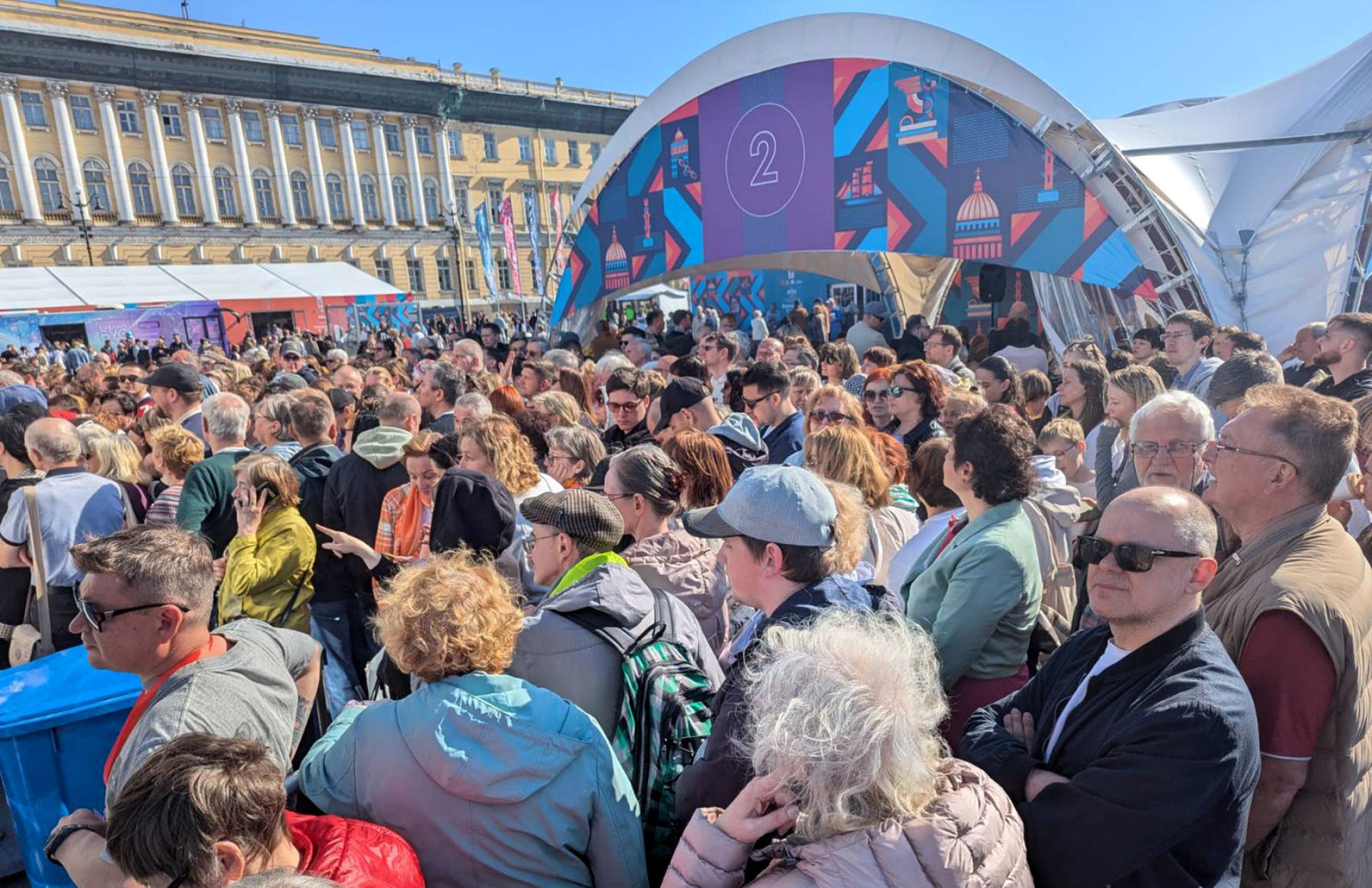
The St. Petersburg International Book Fair took place late last month, from May 21-24. The major literary event featured a number of pro-war writers and Kremlin-sympathetic commentators, including a talk by nationalist author and former State Duma deputy Zakhar Prilepin. Many of Russia’s prominent anti-war writers have fled the country, such as Boris Akunin, Dmitry Glukhovsky, and Vladimir Sorokin. Their books have gradually disappeared from stores as the Kremlin has ramped up its suppression of dissenting viewpoints. “Many books that we’re now afraid to put on sale are just sitting in our warehouses, waiting for better times,” an anonymous bookstore employee told The Moscow Times. (photo: Moscow Times Reporter)
Quickfire: Regions
A military court in Novosibirsk sentenced Aruna Arna, an activist and mother of three children, to five years in a penal colony over reposts of covers of the revolutionary songs “Internationale” and “Varshavianka” on her Telegram channel, which the court interpreted as “incitement to terrorism.” Arna was prosecuted after leading protests last year against the execution of federal municipal reform in her region, the Altai Republic. The reform was adopted last year and several regions are still in the process of carrying it out. It abolished lower-tier municipalities and their organs, with only few exceptions allowed for certain regions with privileged status. Last month, opposition deputies in the Komi Republic suggested a referendum against the scrapping of village councils there. Earlier, several other regions saw protests against the reform, most prominently the Krasnoyarsk Territory and the Altai Republic.
The First Deputy Governor of the Novosibirsk Region, Yury Petukhov, was detained in Moscow. Petukhov is responsible for social policy and domestic politics in the region and has been in office for more than a decade. He was reportedly arrested without the Novosibirsk security services having been informed in advance, although, as of this writing, he has not been formally charged. This happened simultaneously with a separate prosecutor’s investigation into whether Governor Andrey Travnikov’s 2023 election campaign illegally received 20 million rubles from a Chinese businessman, an allegation that first surfaced as testimony in another court case concerning Alexander Zyryanov, the head of the region’s development corporation. While Petukhov was appointed under Travnikov’s predecessor, and the arrest fits into an ongoing wave of corruption crackdowns on members of the regional administrative elite, the fact that the security services allegedly made the arrest without the knowledge of local law enforcement and that both Travnikov and his deputy are implicated in a corruption case at the same time is notable. It suggests growing pressure on the governor, similar to the recent pressure on the (since removed) governors of three of the regions bordering Ukraine.
— Andras Toth-Czifra
New Report

In this new report, FPRI Fellow Dr. Suzanne Loftus challenges the common narrative that time favors Russia in its conflict with Ukraine. Instead, Loftus highlights that Russia is suffering massive structural, economic, and geopolitical decline due to unsustainable military spending, historic casualty rates, and a reliance on transactional, weakening foreign partnerships. With Ukraine successfully leveraging technological innovation, deep logistical strikes, and an integrated Western coalition to inflict disproportionate costs, this argues that time actually disadvantages Moscow. It urges the West to maintain its strategic patience and support rather than forcing a premature settlement.
By the numbers
5% - the initial stake that VTB Bank will acquire of WB Bank, Wildberries & Russ’s (RWB) digital financial services provider, in a new strategic partnership between the two companies. “VTB’s branch network, together with RWB’s pickup point network, will become the largest physical presence network in the country,” VTB Bank said in a statement. WB Bank will be able to utilize VBT’s retail branches and ATMs, while VTB will benefit from RWB’s collaboration on artificial intelligence and other digital tools.
678.9 billion rubles - oil and gas budget revenues in May, up 34% year-on-year due to higher global oil prices following the continuing blockade of the Strait of Hormuz. However, this is still 30% lower over the first five months of the year. Despite the May windfall, the overrun still fell short of the federal government’s hopes and was largely offset by subsidy payments to oil companies via the “dampener” mechanism and the reverse excise tax of over 350 billion rubles.
58 - the number of war participants who won in State Duma “primaries” of the ruling United Russia party, with a little over half of them running in single-member districts in September (most of them in major population centers and in the occupied territories). Altogether, 630 ran for candidacy. The opposition New People party also announced that it would nominate at least 10 war participants, with other “systemic” opposition parties also nominating some. The ruling party’s primaries are first and foremost mobilization exercises, and heavy administrative pressure on public employees has been reported from several regions over the past weeks.
4% - the proportion of “foreign agents” (both individuals and organizations) designated by the Russian Ministry of Justice that actually receive foreign financing, according to the Ministry’s own count. This low proportion highlights how the definition of “foreign agent” was expanded over recent years to include various other kinds of loosely defined “influence,” which allows the Russian authorities to designate virtually any critic of the government as a foreign agent.
— Sara Ashbaugh & Andras Toth-Czifra