

Wildberry blast
Ukraine continues to strike Wildberries warehouses



Here’s what you might have missed this week:
Ukraine continued to target Wildberries warehouses with drone strikes, significantly disrupting the Russian economy.
The Federal Security Service issued an arrest warrant for Telegram co-founder and CEO Pavel Durov on charges of facilitating terrorism.
President Putin unexpectedly dismissed the head of Udmurtia, Alexander Brechalov, and replaced him with agricultural official Olga Abramova.
The Bear Market Brief will take its usual hiatus for the month of August. Thank you for reading!
— Sara Ashbaugh
Continuing strikes
Ukrainian drone strikes against the logistics infrastructure of Wildberries, Russia’s largest online retail platform, continued this week. Over the past week, the operations of Wildberries warehouses were disrupted and facilities damaged in St. Petersburg and the Leningrad Region, Yekaterinburg, Udmurtia, the Ryazan and Penza regions, and the Perm Territory, representing almost 15% of the platform’s logistics capacity and severely eating into Russia’s civilian e-commerce architecture. On July 30, Wildberries’s WB Bank made settlement accounts free and cancelled transfer fees for both existing and new clients. The company is reportedly scouting warehouse space in Kazakhstan to move goods out of drone range. The head of the Ukrainian drone manufacturer Fire Point, meanwhile, called for further strikes against Wildberries and Ozon in order to precipitate the collapse of the Russian banking system (due to the credit exposure of VTB, one of Russia’s largest lenders, to Wildberries).
The impact of the strikes on Russia’s economy and social stability is increasingly visible. Not only do the strikes affect the market weight of Wildberries (and its rival Ozon, which was also affected by the strikes), but they also pose broader questions about the Russian state’s ability and willingness to mitigate the domestic consequences of the war in Ukraine. The domestic insurance market is unable and unwilling to underwrite the vastly increased risk of conducting business through e-commerce platforms, which in turn pushes the costs onto either the platforms or the mostly small and medium-sized enterprises that use them. Ozon, for instance, tripled seller cargo-insurance tariffs starting August 27. Wildberries is reportedly asking 800 billion rubles from the Russian government, 300 billion of which would be used to develop its own drone defense system. If, however, the Russian government says yes to these requests, it risks further industries demanding similar help, putting considerable demands on an already-strained wartime budget. While the ruling United Russia party has floated the option of a state-backed military-risk insurance scheme, part of the costs will likely be pushed onto lower-level and state-adjacent budgets. The Leningrad Region has promised subsidized loans and a hotline for affected sellers, and VTB Bank, which is buying 5% of WB Bank, has signaled openness to providing credit support.
While the strikes on Wildberries shifted the focus from Russia’s fuel infrastructure, signs of stress on the domestic fuel market still remain. While Deputy Prime Minister Alexander Novak had earlier said that the situation was “stabilizing,” as of July 26, he conceded that it remains difficult, especially in Siberia. Crisis management has so far partially relied on optimizing logistics to improve the situation at major population centers. The authorities’ latest moves reflect a focus on easily identifiable culprits. The Federal Antimonopoly Service opened price speculation cases in the Nizhny Novgorod Region, the Perm Territory, the Komi Republic, and the Novosibirsk Region. Meanwhile, the Russian Fuel Union sent a letter to Prime Minister Mikhail Mishustin complaining that major, vertically integrated fuel companies are starving independent stations, which, due to their limited opportunities on the wholesale market, need to raise their prices further or risk closures.
Public transit routes have reportedly been cut in several regions as a secondary effect of the fuel crisis; this may develop into an especially acute problem in regions running large deficits where public transit between remote localities relies on budget support. Shortages also affect the agricultural industry. Small farmers in the Chelyabinsk Region warned of a food security threat due to diesel shortages, and similar stress signs have been reported from other regions as well, such as Tomsk and Krasnodar. This in turn may be translated into higher food prices in the coming month, further raising domestic inflationary pressure.
— Andras Toth-Czifra
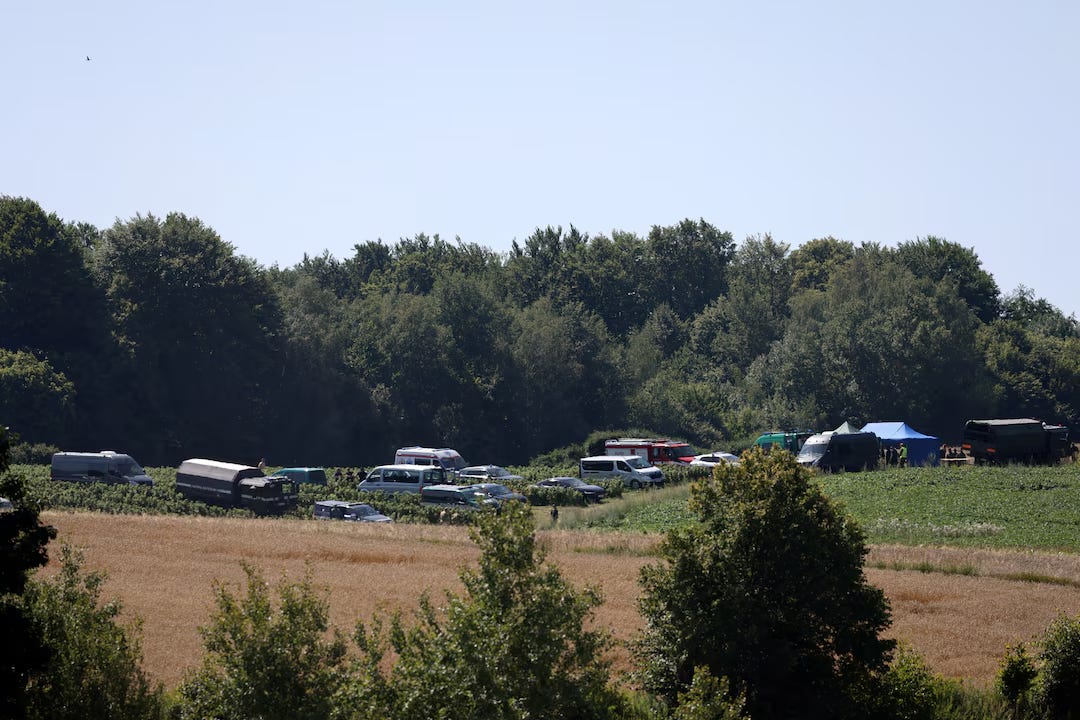
The unidentified object that crashed into eastern Poland overnight on Thursday appears to be a Russian missile, according to Polish Prime Minister Donald Tusk. Polish military personnel, law enforcement, and emergency services gathered at the explosion site near the village of Tarnawa-Kolonia to investigate the crater and debris. “All the indications are that it was a Russian Kh-101 ballistic missile, but we want to be 100% certain about the type of missile and who launched it,” Tusk said during an emergency meeting. “We were ready to shoot it down had it continued its flight,” he added. (photo: Reuters / Kuba Stezycki TPX Images of the Day)
Telegram CEO accused of terrorism
On Wednesday, the Federal Security Service (FSB) issued an arrest warrant for Telegram co-founder and CEO Pavel Durov for facilitating terrorism. According to the FSB’s statement, Telegram’s leadership failed to remove numerous channels and bots used by Ukrainian intelligence agencies to “prepare and coordinate acts of sabotage and terrorism, mass murder, and cyber fraud.” For example, the FSB claims that dozens of young Russians using the Telegram dating bot “Leonardo Dayvinchik” were recruited by Ukrainian intelligence agencies to commit crimes in Russia. 46 of them have reportedly been detained. Russia’s financial monitoring agency, Rosfinmonitoring, also added Durov to its list of “terrorists and extremists,” freezing his assets in Russia.
In response, Telegram’s official X account posted a picture of Durov giving the middle finger. Previously, Durov has accused Russian authorities of using investigations against him as a pretext for restricting access to Telegram. “A sad spectacle of a state afraid of its own people,” Durov said in February, when he first learned that he was being investigated for terrorism. Telegram has 96 million Russian users, but the app has been increasingly difficult to access in the country without the use of a VPN. Russians report throttled loading speeds, blocked video and voice calls, and intermittent restrictions in various parts of the country. There have long been rumors that Roskomnadzor, Russia’s media monitoring agency, plans to block Telegram entirely. The authorities almost certainly want to push users to switch to MAX, Russia’s state-developed messenger app. However, according to Rosfinmonitoring, Durov’s inclusion on the terrorist and extremist list does not restrict access to Telegram itself, and Russians can still safely pay for digital services on the app.
Durov is a citizen of France and the United Arab Emirates. He currently resides in Dubai.
— Sara Ashbaugh
Quickfire: Regions
In a surprise move on July 29, Vladimir Putin dismissed Alexander Brechalov, the head of Udmurtia (one of Russia’s key defense production regions), “by his own request” and appointed Olga Abramova to the position. Abramova will have to stand for office in regional elections, but not until 2027. The timing of the move is nonetheless remarkable. The Kremlin usually removes governors in April or May to allow new regional heads enough time to prepare for that year’s upcoming votes, or in late fall, after the elections held in September. Brechalov’s dismissal seems to have been a hasty decision, and the dismissed governor—who also heads the regional list of the ruling United Russia party for this year’s State Duma election—was still posting on social media very shortly before the change was announced. While Brechalov has had friction with local elites and the municipal leadership of the regional capital Izhevsk, he was not considered a particularly bad governor. It is possible that Brechalov, who is considered an ally of Duma Speaker Vyacheslav Volodin, simply wanted to be transferred to the federal legislature. Unlike him, Abramova is an official with local roots, which Putin emphasized while introducing her. She has also developed connections to Deputy Prime Minister Dmitry Patrushev as an adviser for the federal Agriculture Ministry. The move may thus suggest that, after the corruption cases affecting several regional leaders over the past years, a seat in the Duma close to the decision-making centers in Moscow is considered to be a safer position, especially for officials without personal links to the regions that they lead.
On July 29, а Moscow court convicted former Belgorod Region Deputy Governors Rustem Zainullin and Vladimir Bazarov for embezzling funds during the construction of defensive fortifications on the Russia-Ukraine border. The two deputy governors were given 19 and 20 year prison sentences, respectively, with similarly long sentences meted out to other officials in the region who were also defendants in the case. The verdict mirrors similar cases against Kursk Region officials. In that region, which was subject to an incursion by the Ukrainian army in 2024-2025, the case also led to the imprisonment of one of the region’s former governors and the apparent suicide of another. In May, Belgorod’s then governor, Vyacheslav Gladkov, resigned and was later appointed as Russian envoy to the Georgian breakaway region of Abkhazia—a significant demotion. Alexander Bogomaz, the former head of the Bryansk Region (where similar probes were also launched), resigned together with Gladkov and now sits on the State Duma. So far, no criminal cases have been launched against them. However, the handling of corruption involving defensive fortifications suggests a desire on behalf of the security elite to make an example out of the officials involved.
— Andras Toth-Czifra
In The Latest Russia-Belarus Non-Strategic Nuclear Exercise, Putin and Lukashenka Show Teeth
By Gabriela I. Rosa-Hernandez & Decker Eveleth

In mid-May, Belarus and Russia announced that they would conduct military exercises involving the delivery of nuclear weapons to units in the field. Over the next three days, imagery emerged of Russian and Belarusian forces practicing for the employment of nuclear weapons, including mock deliveries of nuclear warheads to Belarusian missile units. The exercises were trumpeted by both Russian and Belarusian political leadership as an important step in achieving both Russian and Belarusian security against foreign threats. President Vladimir Putin said this exercise was the first joint training of the Russian and Belarusian armies on the management of strategic and tactical nuclear forces since Russia and Belarus announced their nuclear-sharing arrangement—perhaps the most significant change in Russia’s nuclear posture since its full-scale invasion of Ukraine.
By the numbers
8.2 trillion rubles - the new forecast by the Central Bank of Russia for this year’s federal budget deficit. At its July 24 board meeting, the Central Bank embedded in its medium-term forecast a federal budget deficit of 3.6% of GDP (assuming a primary structural deficit of 2%), which, together with current GDP projections, would result in the above figure. The growth of the deficit is primarily due to higher-than-anticipated war-related spending.
11 - the number of parties that are allowed to run in the State Duma election on September 18-20 without collecting signatures. The most notable development this week was that the electoral authorities registered Yabloko, Russia’s only openly anti-war party. Letting the party contest the election, however, does not mean unhindered campaigning. Candidates of both Yabloko and the Communist Party have faced pressure from law enforcement and electoral authorities.
$192 million - the settlement awarded to Silicium-2, a Russian financial shell company, in its lawsuit against the Belgian financial group Euroclear. Silicium-2 originally sued Euroclear for $417.5 million in damages (later increased to $2.2 billion) in May 2025 for blocking its securities. These securities were frozen in the National Settlement Depository’s accounts at Euroclear in 2022 due to international sanctions. The Moscow Arbitration Court ruled in favor of Silicium-2, albeit awarding a smaller settlement than originally requested. While Russian courts have no jurisdiction in the EU, this ruling could be used as justification to seize Euroclear’s remaining assets in Russia.
— Andras Toth-Czifra & Sara Ashbaugh