

Budging the budget
The Russian government is considering revising its 2026 federal budget



Here’s what you might have missed this week:
According to Finance Minister Anton Siluanov, the 2026 Russian federal budget may require early revisions due to declining oil and gas revenues.
Local authorities in several Russian cities prevented protests over increasingly severe mobile internet blockages.
Businessman Umar Dzhabrailov reportedly committed suicide at a luxury apartment complex in Moscow after several political and financial scandals.
— Sara Ashbaugh
Budget troubles
This week, Finance Minister Anton Siluanov acknowledged that the 2026 federal budget may already require revision due to deteriorating external conditions, specifically falling revenues from oil and gas sales. According to Siluanov, this shortfall is accelerating a planned revision of the so-called “budget rule,” which specifies when hydrocarbon revenues are funneled into the National Welfare Fund. Under the current rule, the cut-off price is $59 per barrel, but Russia’s Urals blend sold at an average of $54.20 per barrel in January, increasing the deficit and risking a faster drawdown of reserves. A revision of the rule would see a reduction of the oil price. Siluanov nonetheless insisted that social obligations, investment under the National Projects, and technological initiatives would remain fully funded.
This might be true for the federal budget, for now, but regions that execute a major part of social spending (as well as the funding of education, health care, and housing programs) are already cutting these expenditures in budgets that have been increasingly under pressure.
The legislature of the Maritime Territory, for example, approved a correction of the budget last week that cut expenditures on education, health care, and social services, among other things. The Chelyabinsk Region cut its budget in January. Many regions already revised their spending downwards in 2025, with spending on housing, public services, and transfers to municipalities among the headings facing the biggest cuts. Meanwhile, social security spending went up by 20%, and even more in regions outside of Moscow. Regional debt service costs also grew significantly, as several regions had to take out loans to cover growing debt. The independent news site NeMoskva remarked on the growing trend of municipalities, often highly dependent on regional transfers, introducing “self-taxation,” a form of participatory budgeting to extract more resources from locals for local needs.
This does not affect only poor regions. In a significant move, both Moscow and the Moscow Region, which is independently administered from the city, announced simultaneous 15% reductions in their civil service headcounts. Moscow Mayor Sergei Sobyanin said that this was because the capital’s budget revenue growth in the first two months of the year was just 2%, against a planned 6.5%. Moscow will also cut its investment program by 10%, all while keeping expenditures on war-related programs—including social support to soldiers’ families—protected. The Moscow Region government attributed the cuts partly to AI-driven automation of routine administrative tasks. However, the region’s expenditures in 2025 also grew twice as fast as its own revenues (similarly to other regions). Moscow and the Moscow Region often execute policies as a signal for other regions to follow.
These unusually early revisions signal that both federal and lower-level budgets are unsustainable under current circumstances. Growing global oil prices—a side effect of the conflict in the Middle East—may provide temporary relief to the federal budget, but are unlikely to help most regional budgets. These budgets face collapsing corporate income taxes, consistently high war-related expenditures, and a lack of sufficient reserves. This may result in liquidity problems and a more significant crackdown on some forms of corruption to increase spending efficiency.
— Andras Toth-Czifra
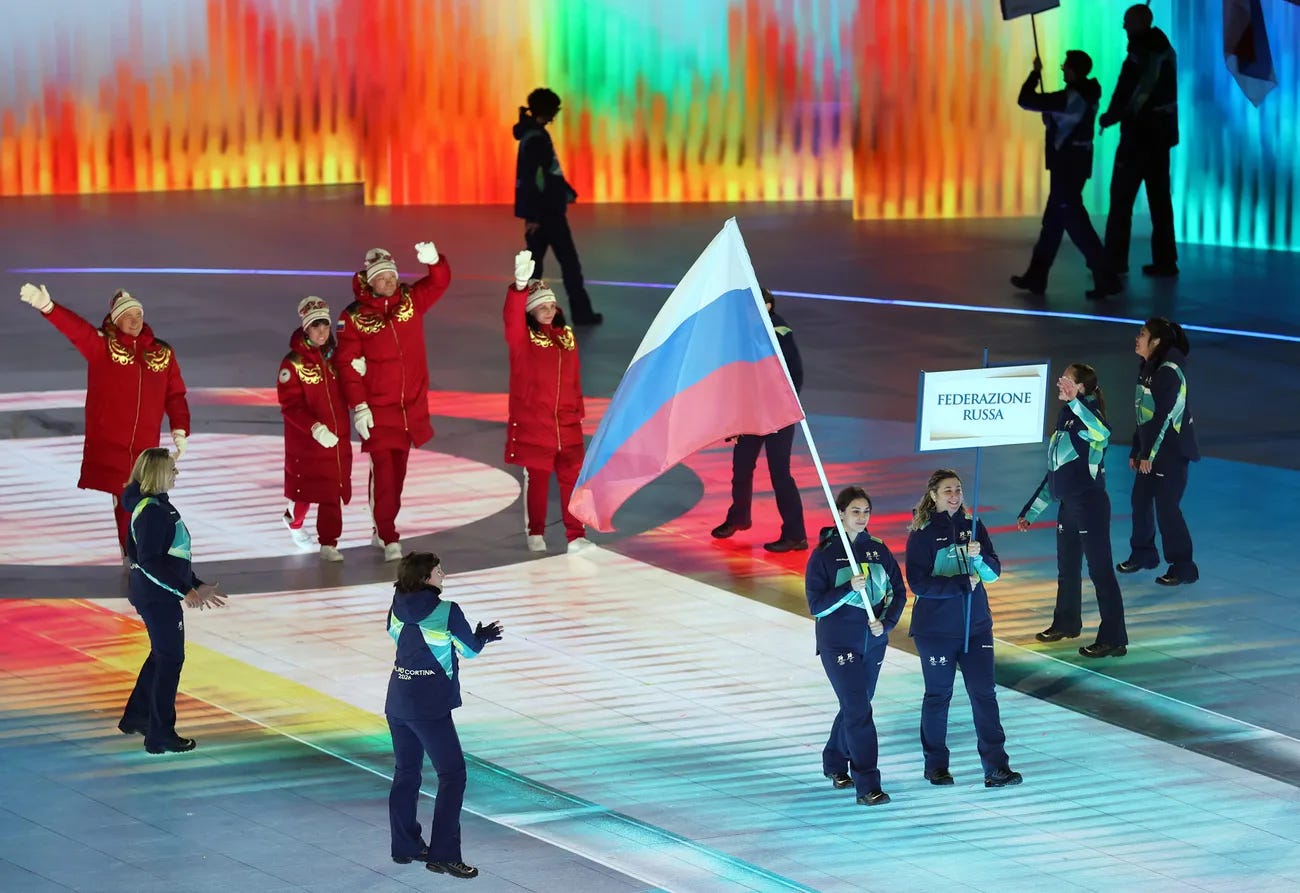
The Russian flag was displayed during the opening ceremony of the Paralympic Games on Friday for the first time since 2014. The International Paralympic Committee (IPC) reversed an earlier decision that banned Russia from competing in the Games, eventually allowing six Russian athletes to participate under their national flag and anthem. As a result, seven countries boycotted Friday’s opening ceremony in Verona in protest, including the Czech Republic, Estonia, Finland, Latvia, Lithuania, Poland, and Ukraine. IPC President Andrew Parsons justified the Committee’s decision to allow Russia to compete, saying, “In a world where some countries are better known by the names of their leaders, I prefer to know the countries by the name of their athletes.” (photo: Luke Hales / Getty Images)
Quickfire: Regions
Protests against increasingly severe mobile internet blockages and the effort to fully ban the use of the Telegram messaging app were attempted in multiple Russian cities over the past week. Local authorities denied or revoked permits in Barnaul, Irkutsk, Petropavlovsk-Kamchatsky, and Vladivostok using various justifications, ranging from denying that internet blockages exist to citing the risk of the planned protest “exceeding the declared number of participants.” A rally in Khabarovsk was approved by the authorities, while in Novosibirsk, organizers proceeded at a pre-designated free-speech zone where no permit is legally required. According to the latest press reports, rather than “negotiating” with Telegram, the Kremlin has come to a final decision to fully throttle the app in Russia starting April 1. Earlier, people with various backgrounds, from private sector companies to war bloggers and even regional officials, expressed concern over the throttling and planned banning of Telegram.
Umar Dzhabrailov, a businessman and former member of the Federation Council from Chechnya, reportedly shot himself dead at a luxury apartment complex in Moscow on March 2. According to reports, all of his accounts across five banks had been blocked by the tax authorities shortly before his death. Dzhabrailov, who once managed major Moscow real estate assets and ran for president in 2000, previously attempted suicide in 2020. His political career had been in decline since 2018 when he was expelled from the ruling United Russia party for shooting a gun in a Moscow hotel while under the influence of narcotics. In early February, it emerged that he was mentioned in the Epstein files for having arranged a meeting in Moscow with Ghislaine Maxwell, Jeffrey Epstein’s partner. According to anti-corruption analyst Ilya Shumanov, Dzhabrailov may simply have outlived his usefulness to the political establishments in Moscow and Chechnya, which once used him as an intermediary.
— Andras Toth-Czifra
From the frontlines
FPRI Senior Fellow Rob Lee and the Kyiv Independent’s Francis Farrell speak with Lieutenant Colonel Yevhen Bespalov, the Commander of Ukraine’s 38th Marine Brigade, about the current situation in Myrnohrad, the role of Russia’s Rubicon Center, how Ukrainian forces navigate constant Russian pressure, the heavy use of glide bombs, and a significant enemy manpower advantage.
Numbers of the week
4 - the number of former deputies of Security Council Secretary Sergey Shoigu, from his time as Russia’s Defense Minister, who have faced criminal prosecution since Shoigu’s transfer to the Security Council in 2024. Ruslan Tsalikov, a long-time associate of Shoigu, was arrested on charges of running a criminal organization, embezzlement, and bribery this week. In 2024, Tsalikov tried to get immunity by becoming a member of the Federation Council from Tuva, Shoigu’s home region, but failed to get a nomination.
20 years - January and February 2026 were the worst months for Russia’s car market in 20 years, according to AvtoVAZ’s Director of Sales and Marketing Dmitry Kostromin. Kostromin added that the official statistics still understate the trouble car manufacturers are in after high interest rates and a squeeze on household disposable income has led to a collapse in new car sales.
40 - the number of Russian regions (out of 83), which have accumulated some degree of experience with online voting (not counting the occupied Sevastopol). According to Vedomosti, electoral authorities will only want these regions to conduct online voting in the September Duma elections. In recent years, the Kremlin has pushed for a widespread rollout of online voting in a bid to reduce both voting transparency and reliance on local officials, although several regions have pushed back against this.
0.51 degrees Celsius - the amount by which the air temperature in Russia has increased over the last ten years, according to a recent Roshydromet report on the country’s climate. This is more than double the global average of 0.2 degrees Celsius. 2025 was Russia’s second-hottest year on record, behind only 2020, and Russia also experienced 110% of its usual precipitation in 2025.
308,000 people - the number of people currently incarcerated country-wide in Russia, according to Supreme Court First Deputy Chief Justice Vladimir Davydov. This is a 70% decrease compared to 25 years ago, when the number of inmates in Russian prisons was roughly 1 million. Davydov attributed the decrease to the “humanization” of Russian law enforcement. However, he did not acknowledge the Russian military’s efforts to recruit thousands of prisoners to fight in Ukraine, which has also reduced the overall number of incarcerated people.
— Andras Toth-Czifra & Sara Ashbaugh