

At your service
A new law expands the FSB's power to block Russians' internet service



Here’s what you might have missed this week:
The State Duma passed a law allowing the Federal Security Service to further restrict internet access in Russia.
Roskomnadzor accused Telegram of allowing users’ data to be stolen and sold by third-party services.
Steelmakers reported a 16% drop in revenue, sparking concerns about a potential crisis in the industry.
— Sara Ashbaugh
New powers for the FSB
The State Duma passed a law expanding the authority of the Federal Security Service (FSB) to shut down communications networks. In the future, network operators will be obliged to block both wireless and landline internet services upon request, even if there is no imminent security threat. The law allows the president to determine the circumstances in which such measures must be taken in a classified decree, essentially allowing Putin to order a suspension of service at will, either regionally or countrywide.
In the past, Russian authorities have experimented with shutting down mobile internet in certain areas during mass protests. Many Russian regions experienced a wave of intermittent mobile internet shutdowns over the past year. These were ostensibly a consequence of Ukraine’s successful “Operation Spiderweb,” which partially relied on Russian mobile networks. At the end of last year, several regional authorities decided to block mobile internet completely until the end of the war, allowing access only to online services on a pre-determined “white list.” This led to complaints not only from citizens, but also from certain public officials, such as Kamchatka Governor Vladimir Solodov.
The current law centralizes decision-making and implementation and also makes it impossible for users to sue telecommunications operators for the outages, as some tried to do last year. However, the absence of legal recourse also leaves citizens without an outlet to channel their frustration with disruptions caused by mobile internet shutdowns, so it remains to be seen how broadly the authorities will apply the restrictions. Ultimately, the goal seems to be the full separation of the Russian internet from foreign and independent (unsupervised) services and content.
The law fits into a recent series of legislative proposals and executive measures that aimed to tighten control over the digital services accessible to Russians, including a recent (partially successful) attempt to block the Telegram messaging app and a proposal to grant the FSB wider powers to monitor the digital footprint of Russian citizens. Overall, the FSB’s domestic powers, as well as the agency’s budget, have been gradually and steadily expanded since the start of Russia’s full-scale invasion of Ukraine.
— Andras Toth-Czifra
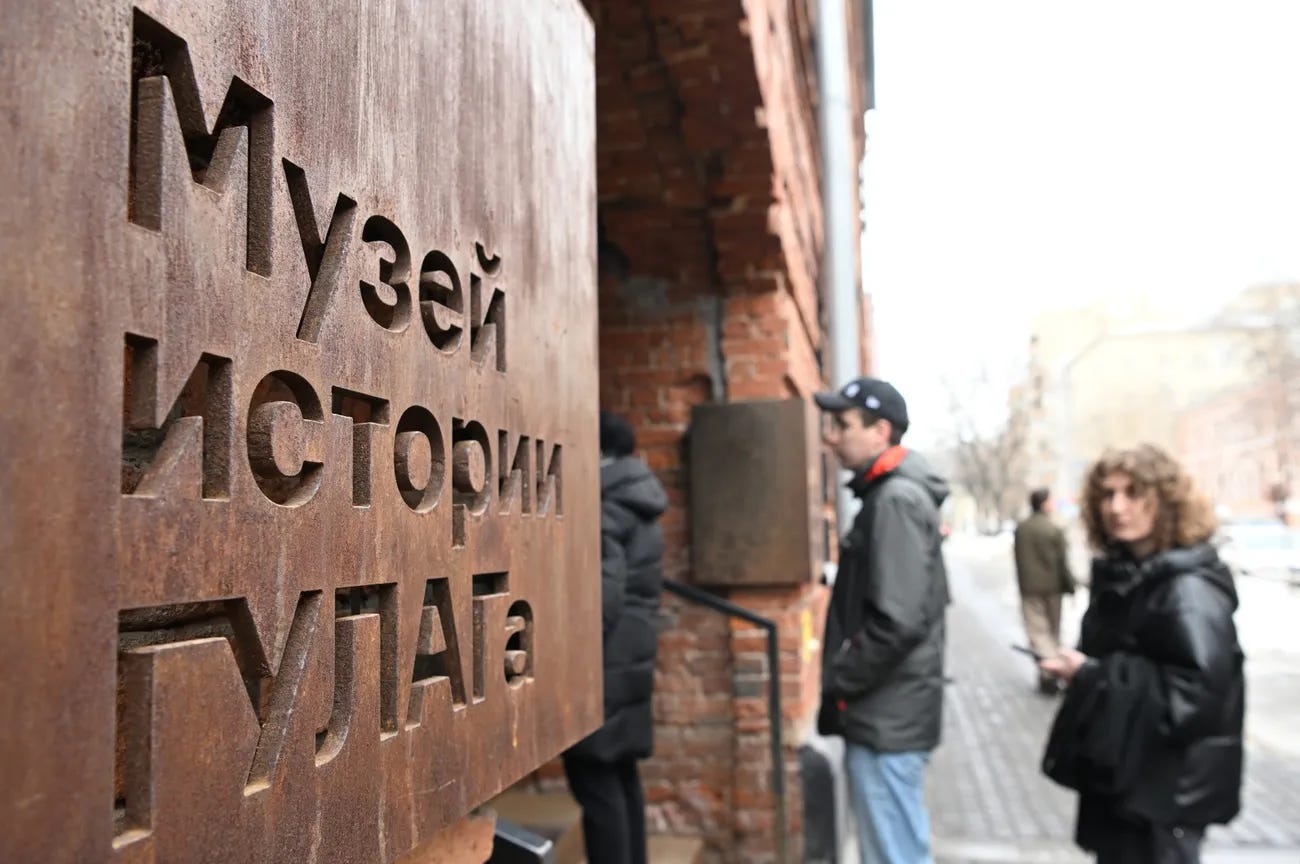
The Gulag History Museum in Moscow, pictured here, will be replaced by a new “Museum of Memory” dedicated to the “victims of the genocide of the Soviet people,” according to a statement on the Museum’s website. The Gulag History Museum was abruptly closed in November 2024 due to “fire safety violations,” although many speculated that the real reason was political. The Museum of Memory will feature exhibits on Nazi war crimes during the Great Patriotic War, using archival materials collected by the “No Statute of Limitations” Project. It is expected to open in 2026. (photo: Kristina Kormilitsyna / RIA Novosti / Sputnik / Profimedia)
Accusations against Telegram
After introducing additional restrictions on the social media platform Telegram last week, Russian authorities have now leveled new accusations against the messenger. According to Roskomnadzor, Russia’s federal media agency, Russian citizens’ information is being leaked from the website and distributed in the form of “personal dossiers.” Roskomnadzor accused Telegram of failing to crack down on so-called “probiv” services, which collect and sell personal information about its users. Although Telegram agreed to remove up to 100 of these third-party services from the site weekly, “the situation remains fundamentally unchanged: new bots are emerging to search for personal data,” Roskomnadzor’s statement says.
Earlier this week, the Minister of Digital Development, Communications, and Mass Media, Maksut Shadayev, claimed that Russian military information is also being leaked from Telegram. According to Shadayev, foreign intelligence services are accessing Russian military correspondence via Telegram and using it against Russian forces on the battlefield. Telegram is still in use by the Russian armed forces, but Shadayev encouraged military personnel to switch to another messenger. Telegram denied Shadayev’s accusations, telling Reuters that “no breaches of Telegram’s encryption have ever been found.” “The Russian government’s allegation that our encryption has been compromised is a deliberate fabrication intended to justify outlawing Telegram and forcing citizens onto a state-controlled messaging platform engineered for mass surveillance and censorship,” the company said.
According to Baza, citing inside government sources, Telegram may be completely blocked in Russia starting April 1. When asked for a comment, Roskomnadzor said that it had “nothing to add to the previously published information.” While some people, including Z-bloggers, have expressed concern that blocking the app will affect the coordination of Russian troops in Ukraine, the Kremlin refuted this idea. “I don’t think it’s possible to imagine frontline communications being provided via Telegram or any other messaging app. It’s difficult and impossible to imagine,” Kremlin spokesperson Dmitry Peskov said.
— Sara Ashbaugh
Quickfire: Regions
Steelmakers reported to Deputy Prime Minister Alexander Novak a 16% drop in revenue, a 50% average decline in EBITDA, around 3,000 layoffs, and reduced work weeks. Consequently, investment programs have been slashed by 30% and blast furnaces are entering a period of “hot conservation.” The federal government had so far declined most requests to adopt a wide sectoral aid program due to budgetary limitations. The government’s proposal of tax deferments and import restrictions would only save metallurgical companies an estimated 15 billion rubles, and even these are not sure to be adopted. Stricter inspections, which are impacting exports in Russia’s Northwestern seaports, may also weigh down on the sector. The looming crisis of the sector has direct implications for the budgetary security of regions that depend on metallurgy, such as Murmansk, Lipetsk, Vologda, and Chelyabinsk. In 2025, the Vologda Region posted the highest deficit relative to its own fiscal incomes among Russia’s 83 regions. This led some to accuse Severstal, the region’s main employer, of deliberately underpaying corporate taxes due to its owner’s ongoing conflict with the region’s governor.
The Federal Antimonopoly Service (FAS) reported to the government that there has been no increase in utility tariffs in the country other than a planned 1.7% adjustment. The agency ostensibly held an inspection after widespread complaints from people across the country over the past weeks about utility bills rising by more than a third and occasionally more, all while several settlements suffered long outages due to accidents with aging infrastructure. According to providers, this is due to a cold winter and the recalculation of 2025 charges, which citizens can, theoretically, challenge if they think that their bills are inaccurate. Officially, tariffs will only increase in October after federal legislative elections—in many regions by more than 20%, well above projected inflation. Yury Afonin, a Duma deputy from the Communist Party, suggested freezing tariffs until 2028. Utility providers also face pressure to increase investment in crumbling infrastructure. Other than ordering the (inconclusive) FAS probe and “monitoring” the situation, the federal government expects governors to assume the communications burden of rising tariffs. Kaliningrad Governor Alexey Bezprozvannykh, for example, himself ordered a probe into price hikes.
— Andras Toth-Czifra
From the frontlines
FPRI Senior Fellow Rob Lee and the Kyiv Independent’s Francis Farrell speak with Lieutenant Colonel Yevhen Bespalov, the commander of Ukraine's 38th Marine Brigade, about the current situation in Myrnohrad, the role of Russia’s Rubicon Center, how Ukrainian forces navigate constant Russian pressure, the heavy use of glide bombs, and a significant enemy manpower advantage.
Numbers of the week
22.3 billion rubles - the amount of extra revenue that Russian Railways (RZhD) may realize from tariff hikes this year, according to calculations by Reuters, which would cover barely 10% of the company’s stated extra financing needs. Due to severe losses from falling cargo loading, inefficient operations, and pressure to subsidize the coal sector, RZhD has had to cut its investment program, sell properties, and turn to the federal government for help.
5.5 million people - The number of Russians working part-time, according to a recent report by FinExpertiza. The report underlines that the number grew by 12% over the past year. While unemployment remains at historic lows, this increase supports reports that several companies, especially in sectors facing protracted crises, are cutting working hours rather than laying people off, thereby masking growing economic problems.
11 million rubles - The amount of unpaid wages demanded from a city-owned company by bus drivers in Kyzyl in the Republic of Tuva. The mayor of the city promised partial payments to the drivers. The rare labor strike is emblematic of the growing pressure that regional and local budgets have faced over the past two years, as some have struggled to pay public-sector workers.
90 billion euros - the total amount of an EU loan intended for Ukraine. EU leaders agreed on the loan in December 2025 after prolonged negotiations. However, Hungary is now blocking the loan until the flow of Russian gas through the Druzhba pipeline is restored. Oil transit through the Druzhba was halted last month after a Russian attack damaged the pipeline, cutting off supply to Hungary and Slovakia. Since then, Hungary has accused Ukraine of intentionally refusing to repair the damage. “Ukraine is blackmailing Hungary by halting oil transit in coordination with Brussels and the Hungarian opposition to create supply disruptions in Hungary and push fuel prices higher before the elections,” Hungarian Foreign Minister Péter Szijjártó posted on X. “We will not give in to this blackmail,” he said.
2.6% - the overall increase in Russian supermarket prices in January, according to the BBC. Citing data from Rosstat, Russia’s Federal Statistics Service, the BBC reported that many grocery store staples became more expensive at the beginning of this year, including meat, milk, potatoes, and pasta. Compared to two years ago, overall food inflation in Russia is up 18.1%, Rosstat figures suggest. January’s price increases are not surprising considering the recent VAT hike from 20% to 22%, which went into effect on January 1.
— Andras Toth-Czifra & Sara Ashbaugh